
Wembanyama Dominates as Spurs Crush Suns 122–96 in Phoenix
Tuesday, November 10, 2026
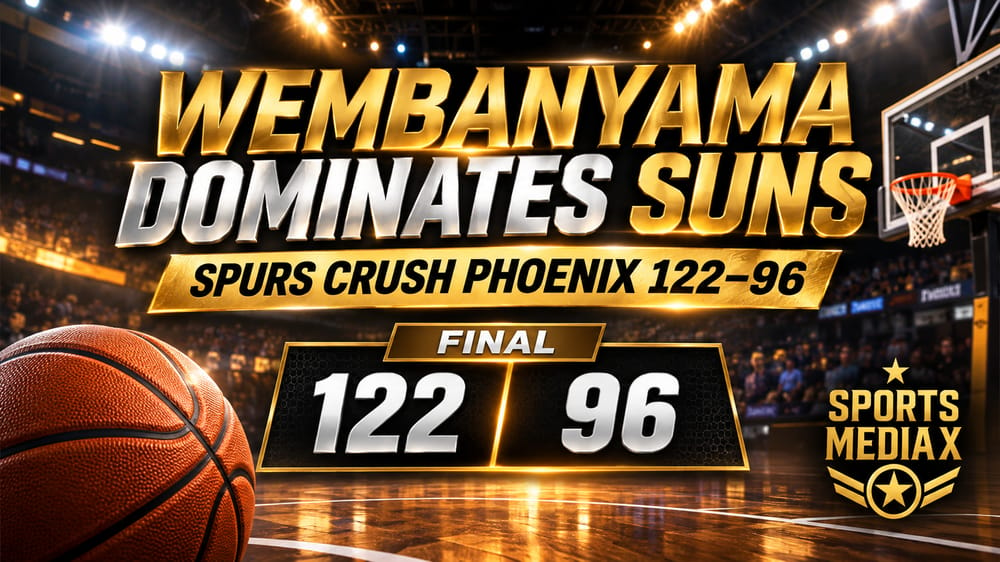
Wembanyama Dominates as Spurs Crush Suns 122–96 in Phoenix
Victor Wembanyama delivers 40 points and nine blocked shots as San Antonio overwhelms Phoenix, exposing serious concerns about the Suns' offensive depth, rebounding, and interior defense.
PHOENIX, AZ — November 10, 2026 — Sports Media X
The Phoenix Suns didn't just lose a basketball game Monday night. They were handed a brutal reminder of how quickly the balance of power can shift in the NBA's Western Conference.
Victor Wembanyama and the San Antonio Spurs marched into Phoenix on November 9 and delivered a commanding 122–96 victory, dismantling the Suns behind an extraordinary performance from their franchise superstar.
Wembanyama finished with 40 points, 11 rebounds, and nine blocked shots, falling just one block short of a rare triple-double while shooting an astonishing 15-of-19 from the field.
For Phoenix, Devin Booker provided the only consistent offensive resistance, finishing with 32 points on efficient shooting. Unfortunately, the Suns couldn't generate enough production elsewhere to challenge a San Antonio team that controlled nearly every meaningful aspect of the contest.
The loss dropped Phoenix to 3–6 on the season and snapped the momentum generated by recent victories over the Orlando Magic and Houston Rockets.
Meanwhile, San Antonio improved to 9–2 and extended its winning streak to nine games, further establishing itself as one of the early-season forces in the Western Conference.
And if Monday night demonstrated anything, it's that the Spurs aren't simply building toward the future anymore.
They're becoming a problem right now.
Victor Wembanyama Turns Phoenix Into His Personal Highlight Reel
There are dominant performances, and then there are performances that make an entire opposing offense rethink how it wants to play basketball.
Wembanyama delivered the latter.
The Spurs' superstar was virtually unstoppable offensively, scoring 40 points on 78.9% shooting while converting two of his three attempts from beyond the arc.
But his scoring was only part of the destruction.
His nine blocked shots transformed the paint into a dangerous place for Phoenix's offense. Suns players were forced to alter attempts, hesitate around the basket, and settle for less favorable scoring opportunities.
That defensive presence had consequences far beyond the official box score.
Wembanyama's ability to protect the rim while remaining a significant offensive threat created a matchup Phoenix simply couldn't solve.
By halftime, he had already accumulated 22 points, six rebounds, and five blocked shots.
The Suns had no effective answer.
What makes the performance even more remarkable is that Wembanyama accomplished his damage in just 25 minutes.
Twenty-five minutes.
He finished with a plus-30 rating, illustrating just how dramatically San Antonio controlled the game during his time on the floor.
For a Phoenix team attempting to establish itself as a legitimate playoff contender, the performance exposed a troubling reality.
The Suns currently lack a reliable defensive solution for an elite interior force with Wembanyama's combination of size, mobility, and offensive versatility.
And the rest of the Western Conference was given another reason to pay attention to San Antonio.
Devin Booker Delivers 32 Points, but the Suns Offer Little Support
If Phoenix had one offensive bright spot Monday night, it was Devin Booker.
The Suns' franchise guard finished with 32 points, four assists, and two rebounds while connecting on 10 of his 17 field-goal attempts.
Booker shot 58.8% from the floor, providing efficient offense against a San Antonio defense that made scoring difficult for nearly everyone else wearing a Phoenix uniform.
Unfortunately, basketball remains a five-man game.
And Monday night, Booker didn't receive nearly enough assistance.
Khaman Maluach finished with 11 points and five rebounds, becoming the only other Suns player to reach double figures.
That means Phoenix received just 21 points from its remaining players after accounting for Booker and Maluach.
Twenty-one points from the rest of the roster.
That level of offensive imbalance is nearly impossible to overcome against a quality opponent, particularly one receiving a 40-point performance from its best player.
The Spurs could devote defensive attention to Phoenix's primary scoring threats without facing consistent punishment from secondary options.
For the Suns, this wasn't simply a poor shooting night.
It was a warning about offensive depth, ball movement, and the importance of developing reliable production beyond Booker.
When one player is responsible for one-third of a team's total scoring, the margin for error becomes dangerously small.
And against San Antonio, Phoenix had almost no margin at all.
San Antonio's Second-Quarter Run Changes Everything
Phoenix remained competitive during the opening quarter, trailing San Antonio 31–25 after the first 12 minutes.
A six-point deficit against a talented Spurs team wasn't ideal, but it certainly wasn't insurmountable.
The second quarter changed the entire complexion of the game.
San Antonio unleashed a devastating 21–2 scoring run that completely disrupted Phoenix's offensive rhythm and defensive organization.
What had been a competitive matchup quickly turned into a game controlled by the visitors.
The Spurs outscored the Suns 30–21 in the second period, carrying a 61–46 advantage into halftime.
That 15-point deficit reflected more than San Antonio's scoring ability.
Phoenix struggled to create quality opportunities, failed to consistently finish possessions with defensive rebounds, and couldn't establish enough offensive rhythm to slow the Spurs' momentum.
Wembanyama's defensive presence compounded those problems, making even routine attempts around the basket considerably more difficult.
By halftime, San Antonio had seized control.
And Phoenix was already facing an uphill battle.
Spurs Deliver the Knockout Blow in the Third Quarter
If the Suns hoped halftime adjustments would change the direction of the contest, San Antonio quickly eliminated that possibility.
The Spurs opened the second half with the same combination of offensive efficiency, physicality, and defensive pressure that had overwhelmed Phoenix before the break.
San Antonio won the third quarter 32–22, extending its lead to 93–68 entering the final period.
A 25-point deficit heading into the fourth quarter left Phoenix with little realistic opportunity to mount a comeback.
Dylan Harper provided another important contribution for the Spurs, finishing with 17 points, including 14 during the third quarter.
His production demonstrated something Phoenix desperately needed but couldn't generate: meaningful secondary scoring.
While Wembanyama commanded attention, San Antonio received timely contributions from other players capable of exploiting defensive opportunities.
The Spurs didn't have to rely exclusively on their superstar.
Phoenix, meanwhile, continued leaning heavily on Booker.
That contrast became one of the defining stories of the night.
The fourth quarter ultimately became a formality, with San Antonio maintaining control and finishing off the 26-point victory.
Rebounding Disaster Exposes Phoenix's Biggest Weakness
The final score was ugly.
The rebounding numbers might have been even more concerning.
San Antonio finished with a staggering 55–35 advantage in rebounds, creating a 20-rebound disparity that illustrated the physical difference between the teams.
Phoenix simply couldn't consistently compete on the glass.
Against a Spurs lineup featuring Wembanyama's extraordinary length and defensive reach, securing rebounds was already going to be challenging.
But the Suns' inability to limit San Antonio's rebounding advantage made an already difficult matchup considerably worse.
Rebounding isn't simply about collecting statistics.
It's about ending defensive possessions, preventing second-chance opportunities, controlling tempo, and generating transition opportunities.
When a team consistently loses those battles, its defense is forced to work harder while its offense receives fewer opportunities to establish rhythm.
Phoenix experienced those consequences throughout Monday night's defeat.
The absence of Mark Williams further complicated the Suns' interior situation, limiting their available size against one of the NBA's most imposing frontcourt opponents.
But injuries and availability issues cannot fully explain a 20-rebound disadvantage.
The Suns need better collective rebounding discipline, stronger positioning, and greater physical commitment from everyone on the floor.
Otherwise, teams with legitimate size will continue exploiting the same weakness.
Phoenix's Offensive Numbers Tell an Uncomfortable Story
The Suns finished the game shooting just 39.3% from the field.
San Antonio converted 51.1% of its attempts.
That difference in efficiency tells a significant part of the story.
Phoenix struggled to generate consistent high-quality scoring opportunities while San Antonio repeatedly found ways to attack the Suns' defense.
The three-point shooting numbers offered little relief.
Phoenix connected on nine of 26 attempts from beyond the arc, finishing at 34.6%.
Although that percentage wasn't disastrous by itself, it wasn't enough to offset the Suns' struggles inside the paint and their lack of offensive production outside Booker.
The assist totals also highlighted the difference between the teams.
San Antonio recorded 30 assists compared with Phoenix's 21.
The Spurs consistently generated scoring opportunities through movement, passing, and offensive execution.
Phoenix's offense was far more dependent on individual production.
That difference becomes especially important against a defender like Wembanyama.
When attacking the basket becomes difficult, teams must compensate through spacing, ball movement, perimeter shooting, and decisive offensive execution.
The Suns didn't consistently accomplish those things.
And the result was one of their most frustrating offensive performances of the young season.
San Antonio's Supporting Cast Makes the Difference
Wembanyama deserved the spotlight, but the Spurs' supporting cast helped turn a strong individual performance into a complete team victory.
Dylan Harper finished with 17 points and five rebounds, delivering his most important offensive production during the third quarter.
De'Aaron Fox contributed 15 points, nine rebounds, and six assists, providing another reliable scoring option while helping San Antonio maintain its offensive rhythm.
Julian Champagnie added 11 points, including three three-pointers, while Harrison Barnes contributed another 11.
Stephon Castle scored just four points but made his presence felt with eight rebounds and seven assists.
San Antonio's offensive versatility created problems that Phoenix never successfully addressed.
The Spurs could attack through Wembanyama, create opportunities with their guards, or find perimeter shooters when the defense collapsed.
Phoenix simply didn't have enough answers.
Dillon Brooks and Jalen Green Struggle as Suns Search for Secondary Scoring
The offensive struggles extended to several players Phoenix needs to produce consistently.
Dillon Brooks finished with seven points on 3-of-14 shooting, an inefficient performance that made it difficult for the Suns to establish offensive balance.
Miles Bridges also scored seven points, connecting on just three of his nine field-goal attempts.
Jalen Green finished with six points on 2-of-8 shooting while adding five rebounds and four assists.
Those three players combined for only 20 points on 8-of-31 shooting.
That level of production places enormous pressure on Booker to manufacture offense, particularly against a defense capable of protecting the paint as effectively as San Antonio.
For Phoenix to become a more competitive Western Conference team, it needs greater consistency from its supporting cast.
The Suns cannot afford extended stretches in which multiple rotation players struggle to produce simultaneously.
Monday night's loss made that painfully clear.
Suns Lose the Battle in the Paint and Transition
San Antonio's dominance wasn't limited to shooting percentages and rebounds.
The Spurs outscored Phoenix 62–48 in the paint, demonstrating their ability to consistently create high-percentage opportunities near the basket.
San Antonio also held a 23–10 advantage in fast-break points.
That 13-point difference in transition scoring reinforced another important issue for Phoenix: the Suns struggled to control the pace and prevent San Antonio from turning defensive stops into offensive opportunities.
The Spurs also doubled Phoenix in second-chance points, winning that category 20–10.
When those three categories are combined, the picture becomes unmistakable.
San Antonio controlled the interior, capitalized on transition opportunities, and made Phoenix pay for its inability to finish defensive possessions.
The Suns were forced to work harder for their points while the Spurs repeatedly created easier scoring chances.
That's not a formula for winning basketball.
Is This a Warning Sign for the Phoenix Suns' Season?
Nine games into an NBA season, it's too early to make definitive judgments about a team's ultimate ceiling.
But it's not too early to identify troubling patterns.
Phoenix entered the season looking to establish a more competitive identity in the Western Conference.
The Suns have demonstrated flashes of that potential, including their recent victories over Orlando and Houston.
However, Monday night's loss exposed weaknesses that cannot simply be dismissed as one bad performance.
The lack of consistent secondary scoring remains a concern.
The rebounding disadvantage against larger opponents is another.
And Phoenix's inability to consistently generate efficient offense when Booker is carrying the scoring burden creates additional challenges.
Perhaps most concerning was the contrast between the two teams' offensive identities.
San Antonio appeared comfortable generating scoring opportunities through multiple players.
Phoenix often appeared dependent on Booker creating something individually.
That difference matters when facing the NBA's better teams.
If the Suns want to compete for a playoff position, they must develop a more balanced offensive attack and establish greater defensive consistency.
Otherwise, performances like Monday night's defeat could become a recurring problem.
Wembanyama's Performance Sends a Message Across the Western Conference
While Phoenix searches for answers, San Antonio continues demonstrating why its early-season success deserves serious attention.
The Spurs have now won nine consecutive games after opening the season with two losses.
Their 9–2 record reflects a team that is rapidly establishing its identity around one of the most unique players in basketball.
Wembanyama's combination of offensive skill, defensive dominance, and extraordinary physical tools makes him a matchup nightmare.
His 40-point, nine-block performance against Phoenix was another example of how he can influence virtually every possession.
Even when he isn't scoring, his presence changes how opposing teams approach the basket.
And when he's shooting nearly 79% from the floor, the challenge becomes overwhelming.
For San Antonio, the emergence of a productive supporting cast makes that equation even more dangerous.
Harper, Fox, Castle, Champagnie, and Barnes provide different offensive and defensive contributions that complement Wembanyama's abilities.
The Spurs are no longer relying exclusively on their superstar to create opportunities.
They're developing into a more complete basketball team.
And that should concern everyone in the Western Conference.
What's Next for the Phoenix Suns? Los Angeles Clippers Visit Tuesday Night
Phoenix won't have much time to dwell on Monday's disappointing performance.
The Suns return to action Tuesday, November 10, when they host the Los Angeles Clippers at Mortgage Matchup Center in downtown Phoenix.
Tipoff is scheduled for 7 p.m. Arizona time.
The matchup presents an immediate opportunity for Phoenix to respond to one of its most disappointing performances of the season.
But the Suns will need a substantially different effort.
Booker cannot be expected to produce another 30-point performance without receiving meaningful assistance.
Phoenix must establish better offensive movement, improve its defensive rebounding, and prevent another opponent from controlling the paint.
The Suns also need stronger contributions from Brooks, Green, Bridges, and the rest of their rotation.
Playing on consecutive nights makes those adjustments even more challenging.
Still, the NBA schedule rarely offers teams the luxury of extended reflection.
Phoenix must find a way to respond immediately.
Sports Media X Final Take: Phoenix Has Bigger Problems Than One Loss
The Phoenix Suns' 122–96 loss to the San Antonio Spurs was more than an embarrassing result on their home floor.
It was a revealing examination of where Phoenix currently stands against one of the Western Conference's emerging powers.
Victor Wembanyama was extraordinary.
Forty points. Eleven rebounds. Nine blocked shots.
And he accomplished it in just 25 minutes.
But focusing exclusively on Wembanyama would overlook the issues that made this game so one-sided.
Phoenix was outrebounded by 20, shot below 40% from the field, and received only 21 points from players other than Booker and Maluach.
Those are not sustainable numbers for a team hoping to compete consistently in the Western Conference.
Booker did his part.
The rest of the Suns simply didn't provide enough.
For San Antonio, Monday night was another statement victory that reinforced its status as a legitimate threat.
For Phoenix, it was a reminder that individual brilliance cannot consistently overcome deficiencies in team execution, rebounding, and offensive balance.
The Suns have talent.
They have opportunities to improve.
And with much of the season still ahead, there is time to correct the problems exposed Monday night.
But improvement requires more than acknowledging what went wrong.
It requires a response.
And that response needs to begin Tuesday night against the Clippers.
The bottom line: Wembanyama dominated the headlines, but Phoenix's lack of offensive support and inability to compete physically are the stories the Suns must address before this season begins slipping away.
Sports Media X delivers independent Phoenix Suns coverage, NBA game recaps, Western Conference analysis, and Arizona sports reporting at SportsMediaX.net.
Past Suns Articles:
Devin Booker Takes Over Late as Suns Beat Rockets 102–99, Spoil Durant’s Return
Booker Ignites Suns as Phoenix Buries Magic to Snap Four-Game Skid
Suns Coverage Home
Phoenix Suns Website

Talking. Covering. Creating. Building.
Learn
Sports Media X Course
SMX Press Box Newsletter
Resource Center
Content
Podcast
Videos
YouTube
Company
About
Contact
Editorial Standards
Fantasy + DFS Policy
Privacy Policy
Terms of Use
© 2026 Sports Media X.
A No Boss No Rush LLC Company.
Scottsdale, Arizona.