
Ryan Blaney Steals Homestead Finale as Kyle Larson Claims Third NASCAR Cup Series Championship
Monday, November 09, 2026
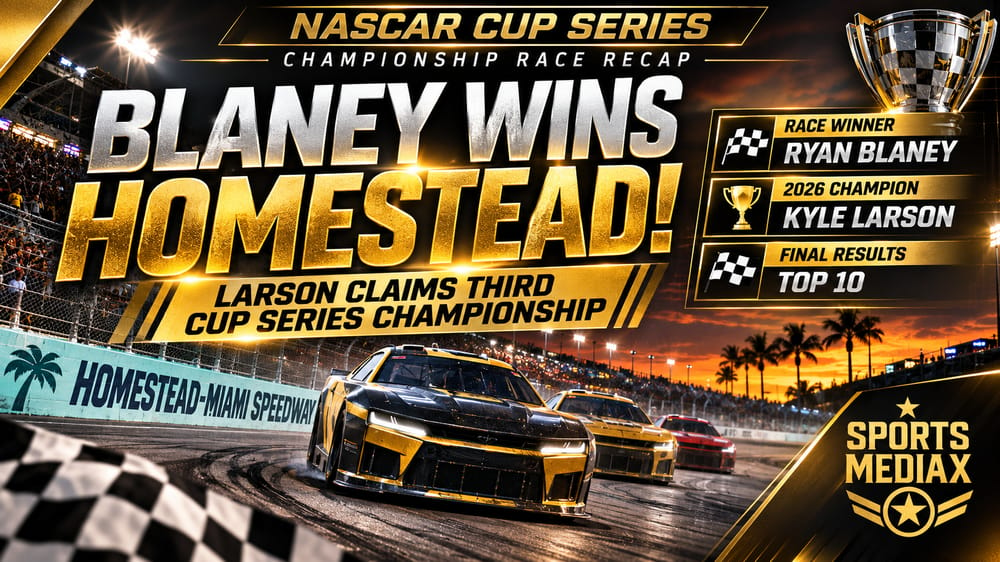
Ryan Blaney Steals Homestead Finale as Kyle Larson Claims Third NASCAR Cup Series Championship
HOMESTEAD, Fla. — November 8, 2026
The checkered flag waved at Homestead-Miami Speedway, but the story of the 2026 NASCAR Cup Series championship finale was bigger than one race, one winner, or even one championship celebration.
Ryan Blaney delivered the kind of finish NASCAR fans dream about, charging past Tyler Reddick as the field approached the white flag to steal the victory in Sunday's season finale. Meanwhile, Kyle Larson completed a remarkable championship journey, securing his third NASCAR Cup Series title and becoming a back-to-back champion for Hendrick Motorsports.
Two drivers. Two celebrations. Two very different roads to NASCAR glory.
For Blaney, it was a race-winning move that transformed a strong afternoon into an unforgettable victory. For Larson, it was the culmination of a postseason resurgence that turned a winless regular season into another championship trophy.
And for NASCAR, the 2026 season ended with a fascinating contrast: a championship decided early and a race victory that came down to the final moments.
Welcome to Homestead-Miami, where the championship belonged to Larson, but the final checkered flag belonged to Blaney.
Ryan Blaney Delivers a Dramatic Victory at Homestead-Miami Speedway
Ryan Blaney didn't dominate Sunday's NASCAR Cup Series championship race.
He didn't lead the most laps, control the opening stages, or spend the afternoon comfortably out front.
Instead, the Team Penske driver did something considerably more important.
He led when it mattered.
Driving the No. 12 Ford, Blaney overcame an additional pit stop earlier in the race, stayed within striking distance of the leaders, and positioned himself perfectly for the closing laps.
When a late caution shuffled the running order and created one final opportunity, Blaney was ready.
Tyler Reddick appeared poised to capture the season-ending victory after grabbing the lead on the final restart. William Byron remained in contention, while Denny Hamlin had already demonstrated that his car possessed race-winning speed.
But Blaney refused to settle.
He worked past Byron, closed the gap to Reddick, and executed the decisive pass as the leaders approached the white flag.
One lap later, Blaney crossed the finish line 0.314 seconds ahead of Reddick.
It was a spectacular ending to a race that had featured multiple contenders, shifting strategies, and several drivers capable of reaching Victory Lane.
Blaney led just seven laps during the 267-lap event.
Seven laps out of 267.
That's all he needed.
The victory gave Team Penske a memorable conclusion to the 2026 season and demonstrated once again why Blaney remains one of NASCAR's most dangerous competitors when the pressure reaches its highest level.
Kyle Larson Wins Third NASCAR Cup Series Championship
While Blaney's victory required a dramatic late-race charge, Kyle Larson's championship celebration began much earlier.
The Hendrick Motorsports driver entered Homestead-Miami Speedway holding a commanding advantage in the NASCAR Cup Series Chase standings.
Larson carried a 67-point lead over Christopher Bell and a 70-point advantage over Denny Hamlin.
Under NASCAR's returning Chase championship format, Larson did not need to win the race to secure the title.
He simply needed to collect enough points to eliminate any remaining mathematical possibility of being caught.
And he accomplished that before the race reached its halfway point.
Larson finished fourth in Stage 1, earning seven valuable stage points. Combined with the circumstances surrounding Chase Briscoe's early retirement, the result was enough to officially secure the 2026 championship.
The title was decided before Stage 2 even began.
For Larson, the accomplishment represents another significant chapter in an already extraordinary NASCAR career.
The No. 5 Chevrolet driver captured his third NASCAR Cup Series championship and second consecutive title, joining an exclusive group of drivers who have reached three championships at NASCAR's highest level.
Even more impressive was the path Larson followed to get there.
He completed the 26-race regular season without a victory.
For a driver known for his ability to win across multiple racing disciplines, a winless regular season could have raised legitimate questions about whether the Hendrick Motorsports team possessed the speed necessary to contend for another championship.
Instead, Larson and his team responded when the postseason arrived.
Three victories during the 10-race Chase transformed the championship picture.
The No. 5 team found its rhythm, capitalized on opportunities, and built the kind of points advantage that allowed Larson to arrive at Homestead with the championship firmly within reach.
By the time Sunday's opening stage concluded, the mission was complete.
Larson eventually finished 12th in the race, but the finishing position mattered little compared with the championship trophy waiting for him.
NASCAR Cup Series Homestead Race Results: Blaney Leads the Top 10
The 2026 NASCAR Cup Series championship finale featured a competitive field and several impressive performances throughout the running order.
Ryan Blaney captured the victory, followed by Tyler Reddick in second and William Byron in third.
Christopher Bell finished fourth, while Bubba Wallace completed the top five after charging forward from his 18th starting position.
Denny Hamlin, who led more laps than any other driver, finished sixth.
Austin Cindric brought his Team Penske Ford home seventh, followed by Daniel Suárez in eighth.
Noah Gragson delivered one of the afternoon's strongest position-gaining performances, climbing from 33rd on the starting grid to finish ninth.
Michael McDowell completed the top 10.
The results demonstrated just how competitive the final race became.
Reddick had the speed to win. Byron controlled portions of the closing stages. Bell and Hamlin were legitimate threats throughout the afternoon.
But Blaney ultimately executed the move that mattered most.
Stage 1: Tyler Reddick Wins as Chase Briscoe's Championship Finale Ends Early
The opening stage began with Chase Briscoe leading the field to the green flag.
Briscoe had secured the pole position with a qualifying speed of 166.687 mph, giving him the preferred starting position for the 400.5-mile finale.
The Joe Gibbs Racing driver looked strong immediately.
Briscoe controlled the opening 34 laps before a slow green-flag pit stop disrupted his momentum.
As the pit-stop cycle unfolded, Christopher Bell and Tyler Reddick emerged as major contenders.
Reddick eventually established himself at the front, demonstrating the speed that would keep him in contention for the remainder of the afternoon.
Then disaster struck Briscoe.
On Lap 78, his engine failed, bringing out a caution and ending what had started as a promising afternoon.
The mechanical failure ended Briscoe's race and sent him to a 39th-place finish.
For a driver who had started from the pole and controlled the opening portion of the event, the result was a devastating conclusion.
Reddick captured the Stage 1 victory, with Blaney finishing second, Bell third, and Larson fourth.
But the biggest development wasn't necessarily Reddick's stage win.
It was Larson's championship.
With the opening stage complete, the points situation officially eliminated Larson's remaining challengers.
The No. 5 team had done enough.
The 2026 NASCAR Cup Series championship belonged to Kyle Larson.
Stage 2: Denny Hamlin Takes Control While Larson Battles Adversity
With the championship decided, attention shifted entirely toward the race victory.
Christopher Bell remained competitive early in the second stage, but Denny Hamlin quickly emerged as one of the strongest drivers on the track.
Hamlin demonstrated excellent long-run speed and positioned himself as a serious contender to win the final race of the season.
The Joe Gibbs Racing veteran eventually took control and captured the Stage 2 victory.
Bell finished second, followed by Reddick in third, Austin Cindric in fourth, and Blaney in fifth.
Meanwhile, Larson encountered trouble.
The newly crowned champion made contact with the outside wall and experienced a tire issue that required an unscheduled pit stop.
The setback dropped Larson through the running order, and he finished the stage 17th.
Under the previous winner-take-all championship format, that kind of problem could have completely transformed the championship outcome.
But under the 2026 Chase format, Larson's title was already secure.
The incident became a race-position problem rather than a championship disaster.
That distinction highlighted one of the most significant differences between NASCAR's returning Chase format and the championship system used in previous seasons.
Final Stage: A Late Caution Sets Up an Incredible Finish
As the final stage unfolded, Hamlin continued to demonstrate race-winning speed.
William Byron also emerged as a serious contender, using the green-flag pit-stop cycle to move into position for a potential victory.
With the laps winding down, the race appeared to be developing into a strategic battle between drivers who had controlled much of the afternoon.
Then everything changed.
With approximately 15 laps remaining, contact involving Noah Gragson and Daniel Suárez sent Suárez spinning and brought out a caution.
Suddenly, the race was no longer simply about long-run speed and pit strategy.
It was about surviving one final restart.
Byron won the race off pit road, followed by Hamlin, Reddick, and Blaney.
When racing resumed, Reddick immediately seized the opportunity and moved into the lead.
Hamlin brushed the wall and lost valuable positions.
Blaney, meanwhile, began his charge.
He moved past Byron and focused on Reddick.
With the white flag approaching, Blaney closed the remaining distance and completed the race-winning pass.
Reddick had controlled significant portions of the afternoon.
Blaney controlled the final moments.
And in NASCAR, that's the difference between second place and Victory Lane.
Denny Hamlin Leads the Most Laps but Comes Up Short
One of the most frustrating results of the Homestead finale belonged to Denny Hamlin.
Hamlin led a race-high 87 laps, more than any other driver in the field.
His performance demonstrated that the No. 11 team had the speed necessary to compete for the victory.
Hamlin won Stage 2 and remained a contender deep into the final stage.
But the late caution changed the complexion of the race.
After restarting near the front, Hamlin made contact with the outside wall and lost the momentum necessary to challenge for the win.
He ultimately finished sixth.
For Hamlin, the result was another example of how quickly a NASCAR race can change.
Leading the most laps doesn't guarantee victory.
Winning a stage doesn't guarantee victory.
And having one of the fastest cars doesn't guarantee victory.
Execution during the closing laps remains essential.
Hamlin had the speed.
Blaney had the finish.
Tyler Reddick Comes Within One Lap of Winning Homestead
Few drivers left Homestead with a more frustrating result than Tyler Reddick.
Reddick won the opening stage, led 53 laps, and demonstrated competitive speed throughout the afternoon.
He remained near the front as the race moved into its closing stages and took advantage of the final restart to grab the lead.
For a brief moment, everything appeared to be falling into place.
Reddick had clean air, track position, and the opportunity to close the season with a victory.
But Blaney was coming.
As the laps disappeared, Reddick could not maintain the gap.
Blaney made the pass approaching the white flag and held on for the win.
Reddick finished second, just 0.314 seconds behind.
It was an outstanding performance that ultimately ended one position short of the result he wanted.
For Reddick and 23XI Racing, Homestead provided another reminder that the organization possesses the speed to compete at NASCAR's highest level.
The challenge now becomes converting those opportunities into more victories.
Christopher Bell, William Byron and Bubba Wallace Deliver Strong Finishes
Several drivers produced performances worthy of recognition beyond the race winner and championship celebration.
William Byron finished third after leading 38 laps and remaining in contention during the closing stages.
Byron's ability to move toward the front during the final pit-stop sequence gave him an opportunity to challenge for the win, but Reddick and Blaney ultimately had the advantage when racing resumed.
Christopher Bell finished fourth after leading 46 laps.
Bell entered the finale as one of Larson's closest championship challengers, but the No. 20 team could not overcome the points deficit during the opening stage.
Despite losing the championship battle early, Bell remained competitive throughout the afternoon.
Bubba Wallace also delivered an impressive performance.
Wallace started 18th and finished fifth, gaining 13 positions over the course of the race.
His top-five result gave 23XI Racing two drivers among the first five finishers, with Reddick taking second.
That collective performance was one of the strongest organizational showings of the afternoon.
Noah Gragson Delivers One of Homestead's Biggest Comeback Performances
While the championship contenders and race leaders dominated the headlines, Noah Gragson produced one of the afternoon's most impressive runs through the field.
Gragson started 33rd and finished ninth.
That's a gain of 24 positions.
On a track where tire management, throttle control, and maintaining momentum through the corners can dramatically influence performance, moving forward that many positions requires a combination of speed, patience, and execution.
Gragson's ninth-place finish deserves recognition as one of the strongest recovery performances of the season finale.
It also provides a positive result to carry into the offseason.
Why Homestead-Miami Speedway Delivered Another Dramatic NASCAR Finish
Homestead-Miami Speedway has long been one of NASCAR's most compelling intermediate tracks.
The 1.5-mile oval rewards drivers who can manage tire wear, maintain momentum, and find speed across multiple racing grooves.
The progressive banking creates opportunities for different approaches through the corners, allowing drivers to search for grip as conditions change.
That flexibility played a major role in Sunday's finish.
Drivers were forced to balance aggression with tire management, particularly during longer green-flag runs.
Track position remained important, but the ability to adjust lines and maintain speed created opportunities for passing.
Blaney's late-race charge demonstrated exactly why Homestead remains such an exciting venue.
Even after the championship had been decided, the race itself delivered the kind of finish that keeps fans watching until the checkered flag.
NASCAR's Returning Chase Format Produces an Unusual Championship Finale
Perhaps the most interesting storyline from the 2026 NASCAR Cup Series finale wasn't what happened during the final lap.
It was what happened before the race reached halfway.
Kyle Larson clinched the championship during Stage 1.
For fans accustomed to NASCAR's previous winner-take-all championship format, that was a dramatic change.
Under the former system, the championship remained undecided until the final race concluded, with the highest-finishing eligible championship contender taking the title.
The returning Chase format instead rewarded cumulative performance across the postseason.
Larson entered Homestead with a substantial points advantage because of what he accomplished during the preceding Chase races.
That advantage allowed him to secure the championship without needing to win the finale or even finish near the front.
There are legitimate arguments on both sides of that approach.
Supporters of the Chase format can point to the value of rewarding sustained excellence across multiple races rather than allowing one afternoon to determine an entire season.
Critics can argue that a championship decided during the opening stage removes some of the suspense traditionally associated with NASCAR's season finale.
Homestead illustrated both perspectives.
The championship battle lacked late-race drama.
The battle for the race victory delivered plenty of it.
Ultimately, Larson's title was earned through the consistency and victories that built his advantage throughout the Chase.
And Blaney's win provided the dramatic finish that the championship battle itself did not.
Kyle Larson's Championship Legacy Continues to Grow
Winning one NASCAR Cup Series championship establishes a driver among the sport's elite.
Winning two demonstrates staying power.
Winning three places a driver in an even more exclusive category.
Kyle Larson has now reached that level.
His 2026 championship adds another major achievement to a career already defined by extraordinary car control, versatility, and the ability to win under pressure.
But this title may stand apart from his previous championships because of the journey required to earn it.
Larson didn't dominate the regular season with a collection of victories.
He entered the postseason without a regular-season win.
Instead of allowing that frustration to define the year, Hendrick Motorsports found another level when the Chase began.
Three postseason victories changed everything.
The No. 5 team transformed from a championship hopeful into the clear points leader.
By Homestead, Larson had created enough separation to secure the title during the opening stage.
That is the kind of postseason performance that defines championship organizations.
And it reinforces Larson's position among the most accomplished drivers of his generation.
Ryan Blaney Gives Team Penske the Perfect Ending to 2026
For Team Penske, Sunday's victory provided an ideal conclusion to the NASCAR Cup Series season.
Blaney's win wasn't built around overwhelming dominance.
It was built around resilience.
The No. 12 team dealt with an additional pit stop, recovered track position, and remained competitive throughout the race.
When the late caution created another opportunity, Blaney capitalized.
His performance reflected the importance of staying within striking distance even when a race doesn't unfold perfectly.
The fastest car doesn't always win.
The driver who leads the most laps doesn't always win.
Sometimes, the driver who manages the race, survives the setbacks, and executes at the decisive moment takes the trophy.
That's exactly what Blaney accomplished at Homestead.
And it's the kind of performance that gives a team confidence heading into a new season.
What the 2026 NASCAR Cup Series Finale Means for 2027
With the 2026 season complete, NASCAR's attention turns toward 2027.
Hendrick Motorsports enters the offseason celebrating another championship with Larson, while Team Penske carries momentum from Blaney's victory.
Joe Gibbs Racing will evaluate a finale in which Hamlin and Bell demonstrated competitive speed but failed to reach Victory Lane.
23XI Racing can build on the strong performances of Reddick and Wallace, who finished second and fifth.
William Byron remains another driver capable of challenging for victories and championships, while drivers such as Noah Gragson will look to build on encouraging late-season performances.
The returning Chase format will also remain a major topic of discussion.
Larson's championship demonstrated how a dominant postseason points performance can determine the title before the final checkered flag.
Whether that creates a more satisfying championship structure will remain a question for fans, competitors, and NASCAR leadership.
But one thing is certain.
The 2026 season delivered a championship performance worthy of recognition and a finale that produced an outstanding race-winning finish.
Sports Media X Final Take: Two Winners, One Unforgettable NASCAR Finale
The 2026 NASCAR Cup Series season ended with two very different examples of what it takes to succeed at the highest level of stock car racing.
Kyle Larson demonstrated the value of championship consistency.
Ryan Blaney demonstrated the importance of capitalizing on the moment.
Larson didn't need to win Homestead because his Chase performance had already created the advantage necessary to secure the championship.
Blaney didn't need to dominate Homestead because he delivered when the opportunity to win presented itself.
One driver built his championship across an entire postseason.
The other captured the final victory of the year with a perfectly timed charge.
And both deserve their place in the headlines.
Larson leaves Homestead as a three-time NASCAR Cup Series champion and back-to-back title winner.
Blaney leaves Homestead as the driver who stole the show with a thrilling late-race pass.
The championship trophy belongs to Kyle Larson.
The final checkered flag belongs to Ryan Blaney.
And the 2026 NASCAR Cup Series season belongs in the history books.
That's racing. That's championship pressure. And that's NASCAR.
For more NASCAR Cup Series news, race recaps, championship analysis, and fantasy NASCAR coverage, stay connected with Sports Media X at SportsMediaX.net — where the stories go beyond the scoreboard.

Talking. Covering. Creating. Building.
Learn
Sports Media X Course
SMX Press Box Newsletter
Resource Center
Content
Podcast
Videos
YouTube
Company
About
Contact
Editorial Standards
Fantasy + DFS Policy
Privacy Policy
Terms of Use
© 2026 Sports Media X.
A No Boss No Rush LLC Company.
Scottsdale, Arizona.