
Phoenix Suns Fall to Oklahoma City Thunder 125-114: Devin Booker's Three-Point Night Exposes Bigger Problems in Phoenix
Tuesday, October 27, 2026
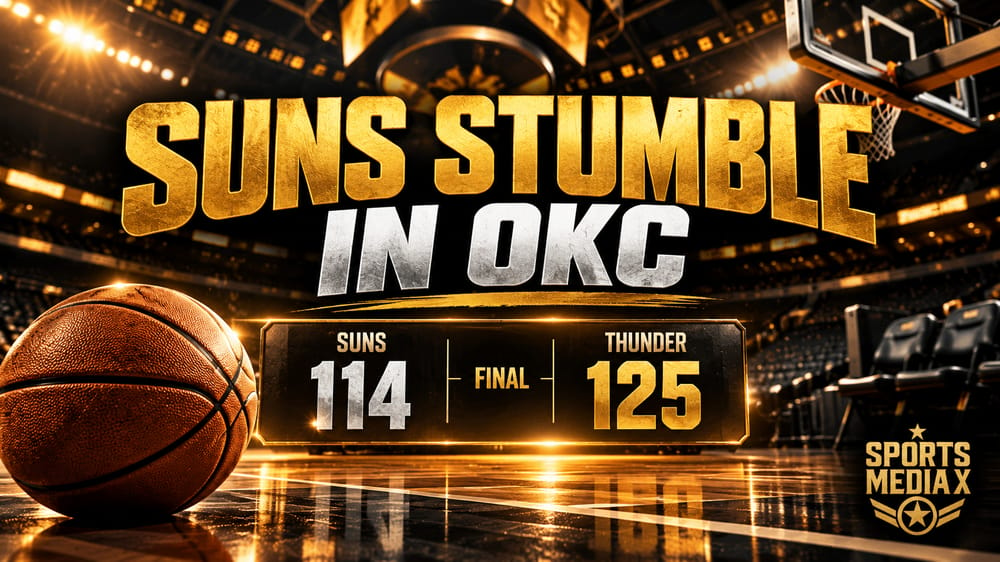
Phoenix Suns Fall to Oklahoma City Thunder 125-114: Devin Booker's Three-Point Night Exposes Bigger Problems in Phoenix
OKLAHOMA CITY, Oklahoma — October 26, 2026 — The Phoenix Suns entered Monday night's matchup against the Oklahoma City Thunder hoping to build momentum following an impressive victory over the Golden State Warriors. Instead, Phoenix walked out of Oklahoma City with a frustrating 125-114 defeat, a disappointing performance from franchise cornerstone Devin Booker, and some serious questions about how this team intends to compete against the Western Conference's elite.
The final score tells part of the story. The bigger picture is considerably more concerning.
Phoenix allowed Oklahoma City to shoot better than 51 percent from the field, surrendered a significant rebounding advantage, and watched Thunder guard Ajay Mitchell explode for a career-high 30 points. Meanwhile, Booker, fresh off a 43-point performance against Golden State, finished with just three points on 1-of-7 shooting.
Three points. From Devin Booker. In 33 minutes.
That's not a statistical line anyone associated with the Phoenix Suns expected to see.
Even more frustrating? Oklahoma City entered the contest without several important contributors, including Jalen Williams, Chet Holmgren, and Cason Wallace.
The Thunder didn't need a full-strength roster to beat Phoenix. They simply needed better execution, stronger defensive possessions, and contributions from players who stepped into larger roles.
For the Suns, now 1-2 on the young 2026-27 NBA season, this was more than another early-season loss. It was a reminder that offensive talent alone doesn't guarantee victories against championship-caliber competition.
And if Phoenix wants to become a serious Western Conference contender, the problems exposed Monday night cannot become recurring themes.
Phoenix Suns vs. Oklahoma City Thunder: How the Game Unfolded
The Thunder established control early inside Paycom Center, building a 33-27 advantage through the opening quarter.
Phoenix generated enough offense to remain competitive, but Oklahoma City's offensive efficiency and ability to create quality scoring opportunities immediately placed pressure on the Suns' defense.
That pressure intensified during the second quarter.
The Thunder outscored Phoenix 34-26 in the period, stretching their advantage to 67-53 at halftime. Suddenly, the Suns were staring at a 14-point deficit against a team that has established itself as one of the NBA's most disciplined and dangerous opponents.
Phoenix needed defensive stops, better rebounding, and a significant offensive response.
Instead, the third quarter produced more of the same.
The Suns scored 32 points coming out of halftime, their best offensive quarter of the night. Unfortunately, Oklahoma City matched that production with 32 points of its own.
Every time Phoenix appeared capable of generating momentum, the Thunder answered.
Oklahoma City's lead reached 17 points late in the third quarter, further illustrating Phoenix's inability to string together enough successful defensive possessions to change the direction of the game.
The Suns won the fourth quarter 29-26, but the damage had already been done.
Oklahoma City closed out the 125-114 victory, improving to 4-0 while handing Phoenix its second loss in three games.
The most troubling part of the evening wasn't that the Suns lost to an excellent Thunder team.
It was how they lost.
Devin Booker's Three-Point Performance Becomes the Biggest Suns Storyline
There is no reasonable way to discuss Phoenix's loss without starting with Devin Booker.
Just two nights earlier, Booker delivered a spectacular 43-point performance against the Golden State Warriors, helping lead Phoenix to a 131-122 victory.
Against Oklahoma City, the Suns' franchise player was almost completely absent from the scoring column.
Booker finished with three points, two rebounds, and seven assists while shooting 1-of-7 from the field and missing both of his three-point attempts.
The seven assists demonstrate that Booker continued to contribute as a facilitator. His ability to create opportunities for teammates remains an important part of Phoenix's offensive identity.
But three points simply isn't enough.
Not from a player expected to anchor the Suns' offense.
Not against a Western Conference rival.
And certainly not when Phoenix is attempting to establish itself as a legitimate playoff contender.
The contrast between Booker's performances against Golden State and Oklahoma City is staggering. Forty-three points in one game. Three in the next.
That's a 40-point difference in individual scoring production over approximately 48 hours.
The Thunder deserve credit for making life difficult offensively, but the broader issue is how Phoenix responds when its best player isn't producing at his usual level.
Can the Suns manufacture quality scoring opportunities through other players? Can they adjust their offensive approach during difficult stretches? Can they win games without requiring Booker to carry the scoring burden?
Those questions matter because the NBA season is far too long for any team to depend on one player delivering an exceptional performance every night.
Booker will have better games. That's hardly in doubt.
The concern is whether Phoenix can develop enough consistency around him to survive nights when the shots aren't falling.
Jalen Green Provides an Encouraging Offensive Performance
If Phoenix needed a positive development from Monday night's defeat, Jalen Green supplied one.
Green led the Suns with 20 points, four rebounds, and four assists while connecting on eight of his 13 field-goal attempts.
That represents 61.5 percent shooting, an impressive level of efficiency against Oklahoma City's defense.
He also committed just one turnover in 30 minutes.
For a Suns team still establishing its offensive identity, Green's performance deserves attention beyond the final scoring total.
He wasn't simply accumulating points through high-volume shooting. He was converting opportunities efficiently, contributing as a playmaker, and protecting the basketball.
Those are valuable qualities for a team attempting to build a more balanced offensive attack.
Green's scoring ability also raises an important strategic question for Phoenix head coach Jordan Ott.
When Booker struggles, should Green become a more prominent offensive option?
The answer might determine how effectively the Suns navigate difficult matchups throughout the season.
Phoenix has enough offensive talent to create multiple scoring threats. The challenge is developing a system that consistently puts those players in positions to succeed.
Green's performance against Oklahoma City provides another reason to explore that possibility.
Dillon Brooks and Miles Bridges Deliver Production, but Efficiency Matters
Dillon Brooks contributed 19 points, five rebounds, and five assists against Oklahoma City, providing another scoring option during Booker's difficult evening.
However, Brooks connected on just four of his 14 field-goal attempts.
His three made three-pointers and eight successful free throws helped compensate for his struggles from the floor, but the overall efficiency left room for improvement.
Miles Bridges added 17 points, eight rebounds, and four assists.
Bridges provided valuable activity on the glass, finishing with a team-high eight rebounds. His offensive efficiency, however, was another concern.
He shot 7-of-17 overall and just 2-of-10 from beyond the arc.
That's a significant number of missed perimeter opportunities in a game where Phoenix needed every possible offensive advantage.
The Suns received scoring contributions from multiple players, but scoring totals alone don't tell the complete story.
Shot selection, efficiency, ball movement, and the ability to recognize favorable matchups are equally important.
Phoenix made 18 three-pointers against Oklahoma City, six more than the Thunder, but that advantage wasn't enough to overcome its struggles in other areas.
For Ott and his coaching staff, the challenge will be finding a more reliable offensive balance without sacrificing the aggressiveness that makes players like Green, Brooks, and Bridges dangerous.
Ajay Mitchell's Career Night Highlights Oklahoma City's Incredible Depth
The biggest individual performance of the evening belonged to Oklahoma City guard Ajay Mitchell.
Mitchell scored a career-high 30 points on 10-of-16 shooting while adding five assists.
He scored 18 points in the first half, helping the Thunder establish the advantage that Phoenix ultimately couldn't overcome.
For Oklahoma City, Mitchell's performance represented another example of why its roster construction has become such a competitive advantage.
The Thunder can withstand injuries, adjust rotations, and still receive meaningful contributions from players outside their most recognizable names.
Shai Gilgeous-Alexander added 26 points, three rebounds, and three assists, giving Oklahoma City another reliable scoring presence.
Jared McCain contributed 18 points, while Isaiah Hartenstein delivered 15 points and 13 rebounds.
Those performances were particularly important considering Oklahoma City's injury situation.
Jalen Williams, Chet Holmgren, and Cason Wallace were unavailable, while Alex Caruso exited the contest with a right ankle sprain.
Yet the Thunder still scored 125 points.
That's the difference between simply having talented players and building a complete basketball team.
Oklahoma City has established a system in which different contributors can assume greater responsibility without completely disrupting the team's identity.
Phoenix is still working toward that level of consistency.
And Monday night demonstrated just how significant that gap can become.
Phoenix Suns Defense Continues to Raise Early-Season Concerns
The most important takeaway from Phoenix's loss might have nothing to do with Devin Booker's scoring struggles.
It might be the Suns' defense.
Phoenix surrendered 125 points to Oklahoma City after allowing 122 points in Saturday's victory over Golden State.
That's 247 points allowed over two games.
Granted, the Warriors and Thunder possess dangerous offensive personnel, and two games are not enough to establish a season-long defensive trend.
But the early warning signs are difficult to ignore.
Oklahoma City shot 51.2 percent from the field, repeatedly finding opportunities to score efficiently.
The Thunder also connected on 37.5 percent of their three-point attempts and converted 25 free throws.
Phoenix struggled to generate enough stops to erase Oklahoma City's first-half advantage.
That's where the conversation must shift from individual performances to team execution.
Defensive success requires communication, positioning, disciplined rotations, rebounding, and a collective commitment to making opponents uncomfortable.
It also requires the ability to respond when an opponent finds a successful offensive approach.
The Suns didn't consistently demonstrate those qualities against Oklahoma City.
Ott's coaching staff now faces an important early-season assignment: establish defensive principles that translate into consistent performance regardless of the opponent.
Phoenix doesn't necessarily need to become the NBA's best defensive team overnight.
But it cannot continue allowing opponents to dictate the game offensively and expect its own scoring talent to solve every problem.
Against elite competition, that formula becomes increasingly difficult to sustain.
Rebounding Problems Give the Thunder Another Significant Advantage
Oklahoma City finished with a 57-49 rebounding advantage over Phoenix.
That eight-rebound difference doesn't fully explain an 11-point defeat, but it reflects another area where the Thunder held an important edge.
Isaiah Hartenstein's 13 rebounds helped Oklahoma City control the glass, particularly on the defensive end.
The Thunder collected 36 defensive rebounds compared with just 24 for Phoenix.
That disparity matters because defensive rebounds end possessions.
When a team struggles to secure rebounds, it becomes more difficult to establish offensive rhythm, control tempo, and prevent opponents from generating additional opportunities.
Phoenix did collect 14 offensive rebounds, demonstrating some encouraging activity around the basket.
But the overall rebounding battle still favored Oklahoma City.
Khaman Maluach contributed 12 points, seven rebounds, and one blocked shot for Phoenix while shooting 5-of-10 from the field.
His production offered another glimpse of the young center's potential, but his four turnovers and four personal fouls also illustrated the developmental challenges that come with expanded responsibilities.
For Phoenix to improve defensively, the responsibility cannot fall entirely on its centers.
Rebounding must become a collective effort involving forwards, guards, and every player responsible for finishing defensive possessions.
Against Oklahoma City, the Suns simply weren't consistent enough in that department.
The Most Frustrating Part? Phoenix Actually Won Several Important Statistical Battles
Here's what makes Monday night's loss particularly interesting.
Phoenix made more three-pointers than Oklahoma City.
The Suns recorded more assists.
They committed fewer turnovers.
And they still lost by 11 points.
Phoenix finished with 18 made three-pointers compared with Oklahoma City's 12. The Suns also recorded 29 assists against 24 for the Thunder while committing just 12 turnovers compared with Oklahoma City's 16.
Those are encouraging numbers in isolation.
But basketball games aren't decided by isolated statistical categories.
They're decided by how effectively teams combine offensive execution, defensive discipline, rebounding, and efficiency.
Oklahoma City shot 51.2 percent from the field compared with Phoenix's 42.9 percent.
The Thunder also made 25 free throws compared with 18 for the Suns.
Oklahoma City's advantage in overall shooting efficiency and free-throw production helped neutralize Phoenix's perimeter scoring.
That's an important distinction.
The Suns didn't necessarily lose because they failed to create offensive opportunities.
They lost because Oklahoma City made better use of its opportunities while limiting Phoenix's ability to generate defensive stops.
For a team searching for consistency, understanding that difference is essential.
Jordan Ott Faces an Important Early Test in His Second Season
Jordan Ott's second season as Phoenix Suns head coach is still in its opening stages, but the expectations surrounding this roster are already significant.
Phoenix has offensive firepower, experienced contributors, and young players capable of developing into important rotation pieces.
What the Suns need now is a more dependable team identity.
The victory over Golden State demonstrated how dangerous Phoenix can become when its offense is functioning at a high level.
The loss to Oklahoma City exposed what happens when that offensive production becomes less reliable and defensive weaknesses begin to accumulate.
Both performances matter.
Neither should be treated as a definitive statement about the Suns' season.
But together, they provide an early picture of the challenges facing Ott and his coaching staff.
Phoenix must find ways to generate consistent scoring beyond Booker, improve its defensive execution, establish more reliable rebounding habits, and develop a rotation capable of responding to different opponents.
Those adjustments won't happen immediately.
But the sooner Phoenix begins making progress, the better positioned it will be to compete in a Western Conference that offers very little margin for error.
Suns Fall to 1-2 While Thunder Improve to 4-0
Monday's result leaves Phoenix at 1-2 through its first three games of the 2026-27 NBA regular season.
Oklahoma City, meanwhile, improves to 4-0 and continues demonstrating the depth and consistency that make the Thunder such a difficult opponent.
For the Suns, the early record isn't cause for panic.
Three games represent a small fraction of an 82-game schedule.
However, the quality of Phoenix's opponents and the specific problems exposed during these matchups make the opening stretch worth evaluating carefully.
The Suns have already shown they can produce enough offense to defeat a talented Golden State team.
Now they must demonstrate that they can compete when the game requires something different.
That means defending for extended stretches, winning physical battles, controlling rebounds, and finding scoring solutions when their primary offensive options struggle.
The best teams don't win every game.
They develop enough flexibility to remain competitive even when their preferred approach isn't working.
That's the next step for Phoenix.
What's Next for the Phoenix Suns? Denver Nuggets Visit Friday
The Suns return to action Friday, October 30, when they host the Denver Nuggets at 7 p.m. Arizona time.
The matchup also marks Phoenix's first NBA Cup game of the season.
Denver presents another challenging test, particularly for a Suns team attempting to improve its defensive consistency and rebounding.
The Nuggets have the offensive versatility and interior presence to punish opponents who struggle with positioning, communication, and physicality.
Phoenix will have several days to evaluate its performance against Oklahoma City and prepare adjustments.
The immediate priorities should be clear.
Booker needs to reestablish his offensive rhythm.
Green's efficient scoring deserves continued emphasis.
The Suns must become more disciplined defensively.
And the entire roster needs to contribute more consistently on the glass.
Friday's matchup won't determine the direction of Phoenix's season, but it will provide another valuable opportunity to evaluate whether the Suns are learning from their early mistakes.
Sports Media X Final Take: Phoenix Has Talent, but Talent Isn't Enough
The Phoenix Suns didn't lose to Oklahoma City because they lack offensive ability.
They didn't lose because Devin Booker suddenly forgot how to score.
And they certainly didn't lose because the Thunder needed every available star to win.
Phoenix lost because Oklahoma City was the more complete basketball team Monday night.
The Thunder executed more efficiently, controlled important stretches of the game, and received outstanding contributions from players asked to handle expanded responsibilities.
Meanwhile, the Suns struggled to defend consistently, lost the rebounding battle, and couldn't overcome an unusually quiet performance from their franchise player.
There are positives worth recognizing.
Jalen Green delivered an efficient 20-point performance. Multiple Suns contributed offensively. Phoenix moved the basketball effectively enough to record 29 assists and protected possession well enough to finish with fewer turnovers than Oklahoma City.
Those developments matter.
But they don't erase the larger issues.
The Suns are talented enough to score with almost anyone when their offense is clicking.
The question is whether they can develop the defensive identity, rebounding discipline, and consistency required to win when it isn't.
That will ultimately determine whether Phoenix becomes a legitimate Western Conference threat or remains a team capable of impressive individual victories without sustained success.
The season is young. There's time to improve.
But Monday night's 125-114 loss to Oklahoma City delivered a message the Suns would be wise to take seriously.
If Phoenix wants to compete with the best teams in the West, it must become a better team on both ends of the floor.
And that starts long before Devin Booker takes his next shot.
Sports Media X — Your game. Your voice. Your sports media experience.
Past Suns Articles:
Devin Booker Drops 43 as Phoenix Suns Bounce Back With 131-122 Victory Over Golden State Warriors
Phoenix Suns Opening-Night Disaster: Portland Embarrasses Phoenix in 41-Point Blowout
Suns Coverage Home
Suns Website

Talking. Covering. Creating. Building.
Learn
Sports Media X Course
SMX Press Box Newsletter
Resource Center
Content
Podcast
Videos
YouTube
Company
About
Contact
Editorial Standards
Fantasy + DFS Policy
Privacy Policy
Terms of Use
© 2026 Sports Media X.
A No Boss No Rush LLC Company.
Scottsdale, Arizona.