
William Byron Dominates Martinsville as Kyle Larson Survives Championship Scare Ahead of NASCAR Cup Series Finale
Monday, November 02, 2026
William Byron Dominates Martinsville as Kyle Larson Survives Championship Scare Ahead of NASCAR Cup Series Finale
By Sports Media X | NASCAR Cup Series | November 1, 2026
The NASCAR Cup Series arrived at Martinsville Speedway with championship pressure building, opportunities disappearing and every position carrying enormous consequences. By the time the checkered flag waved Sunday afternoon, William Byron had delivered one of the most dominant performances of the 2026 season, while Kyle Larson had survived the kind of afternoon that can make or break a championship campaign.
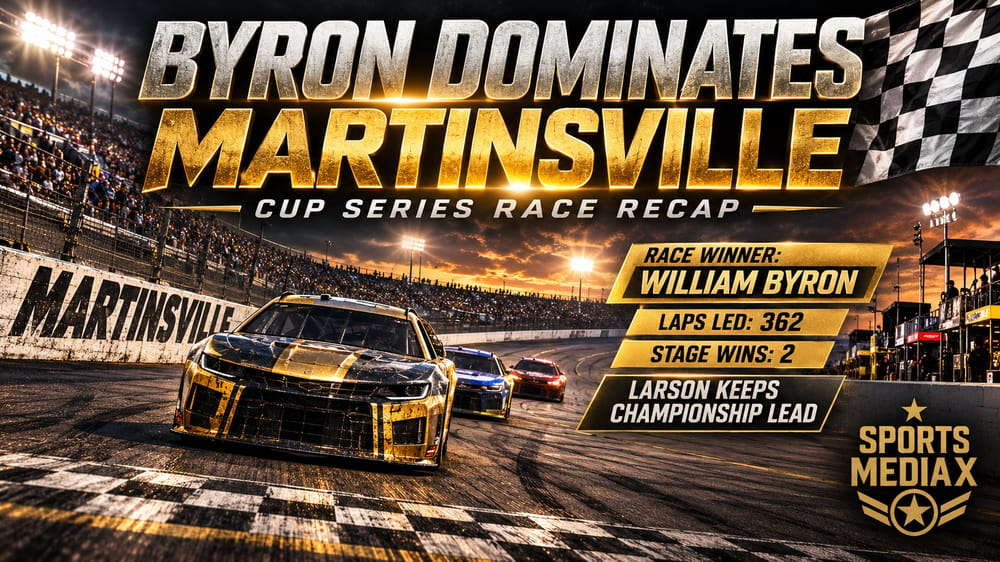
Byron controlled the Xfinity 500 at Martinsville Speedway, leading an extraordinary 362 of 500 laps, sweeping both stages and capturing his first NASCAR Cup Series victory of 2026. The Hendrick Motorsports driver crossed the finish line 2.049 seconds ahead of teammate Chase Elliott, completing a powerful one-two finish for the organization.
Ty Gibbs finished third, followed by Josh Berry and Shane van Gisbergen to complete the top five.
But while Byron celebrated in victory lane, the championship conversation centered on Larson.
The driver of the No. 5 Hendrick Motorsports Chevrolet endured an early strategy disaster, fell a lap behind the leaders and appeared vulnerable to losing a significant portion of his championship advantage. Instead, Larson battled back to finish ninth, preserving a commanding 67-point lead heading into the NASCAR Cup Series championship finale at Homestead-Miami Speedway.
Martinsville delivered everything expected from one of NASCAR's most demanding short tracks: aggressive racing, tire strategy, damaged cars, frustrated contenders and championship implications that extended far beyond the race winner.
And when the dust settled, one thing became clear.
William Byron owned Martinsville. Kyle Larson survived it. And the NASCAR Cup Series championship now heads to Miami with everything still mathematically on the line.
William Byron Delivers a Martinsville Masterclass
There are impressive victories, and then there are performances that leave little doubt about who had the best race car.
William Byron's Sunday afternoon belonged firmly in the second category.
Driving the No. 24 Hendrick Motorsports Chevrolet, Byron demonstrated exceptional speed, tire management and consistency across the 500-lap event. His 362 laps led represented more than 72 percent of the entire race distance, an overwhelming display of short-track superiority.
The victory ended a 35-race winless streak and gave Byron his first Cup Series win of the 2026 season.
It also marked his fourth career NASCAR Cup Series victory at Martinsville Speedway and the 17th Cup Series win of his career.
Byron's dominance was particularly impressive because Martinsville rarely allows drivers to simply disappear from the competition. The half-mile paperclip demands precision under braking, careful throttle application and constant management of traffic. Drivers can have tremendous speed in clean air, only to find themselves trapped behind slower cars or vulnerable during restarts.
Byron navigated those challenges with remarkable consistency.
He won the opening stage, returned to the front during the second stage and maintained control throughout the final segment. Even when Elliott began closing the gap late in the race, Byron responded by maintaining his pace and protecting his advantage.
The result was a statement victory for a driver who had spent much of the season searching for a breakthrough.
For Hendrick Motorsports, the afternoon also reinforced the organization's continued strength at Martinsville. Byron's victory delivered the team's 32nd NASCAR Cup Series win at the historic Virginia short track.
And with Elliott finishing second and Larson preserving his championship advantage, Hendrick Motorsports left Martinsville with plenty to celebrate.
Stage 1: Tire Strategy Creates Early Chaos and Championship Trouble
The opening stage of Sunday's Xfinity 500 immediately demonstrated why Martinsville can punish even the strongest championship contenders.
Denny Hamlin began the afternoon from the pole position, putting himself in an ideal position to attack Larson's points advantage. However, Hamlin's early momentum disappeared almost immediately when he missed a shift, allowing Ty Gibbs to take the lead on Lap 3.
Hamlin eventually recovered and returned to the lead on Lap 45, but the opening stage soon became a battle between competing tire strategies.
As teams evaluated their options, several contenders elected to pit for fresh tires while others remained on the racetrack.
Byron was among the drivers who benefited from fresh rubber.
With superior grip and improved corner speed, the No. 24 Chevrolet charged through traffic and eventually overtook Ryan Preece with six laps remaining in the opening stage.
Byron captured the Stage 1 victory, establishing himself as the strongest driver in the field.
For Larson, however, the situation was dramatically different.
The championship leader remained on the racetrack during the strategic split, attempting to capitalize on track position rather than fresh tires. At Martinsville, where tire falloff can become significant over a long green-flag run, that decision proved costly.
Larson lost substantial ground to the drivers who had stopped for tires and eventually fell a lap behind the leaders.
He also failed to collect stage points, opening the door for his championship challengers to reduce their deficits.
For a driver who entered Martinsville with a substantial advantage, the opening stage represented precisely the type of scenario his team wanted to avoid.
Suddenly, Larson was no longer simply protecting a championship lead.
He was fighting to prevent an early strategy decision from turning into a potentially devastating afternoon.
Stage 2: Byron Continues His Dominance as Martinsville Tempers Flare
The second stage featured another commanding performance from Byron, but the action behind him became increasingly chaotic.
As drivers battled for position on Martinsville's narrow racing surface, contact and frustration began to escalate.
Christopher Bell encountered trouble when a pit-road speeding penalty disrupted his strategy and compromised his opportunity to challenge near the front.
The situation became even more complicated when Joey Logano made contact with Bell, triggering an incident that also involved Hamlin.
Bell and Hamlin spun, creating a caution that altered the complexion of the race.
For Hamlin, the incident represented another setback in an afternoon when he needed to maximize every available championship point.
For Bell, the combination of pit-road trouble and on-track contact prevented him from capitalizing fully on Larson's earlier difficulties.
But for Larson, the caution provided a critical opportunity.
After spending a portion of the race trapped one lap behind the leaders, Larson received the free pass and returned to the lead lap.
That moment may ultimately prove to be one of the most important developments of the entire championship stretch.
Without the opportunity to recover his lost lap, Larson could have surrendered significantly more ground in the standings. Instead, the No. 5 team suddenly had a realistic opportunity to recover and salvage a respectable finish.
Elsewhere, Martinsville continued collecting victims.
Carson Hocevar experienced a spin, Ryan Preece encountered trouble after losing a wheel, and Ryan Blaney suffered damage following contact involving Josh Berry.
Through the interruptions, Byron remained the driver to beat.
He captured the second stage victory, completing the stage sweep and further reinforcing his control of the race.
Two stages were complete, and Byron had established himself as the overwhelming favorite to take the checkered flag.
The bigger question was whether anyone could challenge him over the final 247 laps.
Final Stage: Chase Elliott Makes a Late Push, but Byron Refuses to Break
The final stage of the Xfinity 500 became a showcase of Byron's ability to manage a long green-flag run while maintaining his advantage over the competition.
Martinsville demands patience, particularly when the race reaches its closing stages. Drivers must balance aggression with tire conservation, navigate slower traffic and avoid the mistakes that can quickly erase hundreds of laps of hard work.
Byron handled those responsibilities with remarkable precision.
Elliott emerged as the strongest challenger during the closing portion of the race, giving Hendrick Motorsports a legitimate opportunity to finish first and second.
With approximately 30 laps remaining, Elliott had reduced Byron's advantage to around one second.
For a brief period, the possibility of a late battle between Hendrick teammates appeared realistic.
But Byron never surrendered control.
Rather than allowing Elliott to close the remaining distance, Byron maintained his rhythm through the corners and gradually extended his advantage.
When the checkered flag finally waved, Byron had built a 2.049-second margin over Elliott.
Gibbs crossed the line third, more than 13 seconds behind the winner.
Berry finished fourth, while Shane van Gisbergen completed the top five.
The final results reflected the extraordinary level of control Byron maintained throughout the afternoon.
Only seven cars finished on the lead lap, further illustrating how demanding the 500-lap event became for the field.
Byron did not need a dramatic final restart, a last-lap pass or a perfectly timed caution to secure the victory.
He simply had the strongest combination of speed, execution and consistency.
And at Martinsville, that combination is extremely difficult to beat.
NASCAR Martinsville Results: William Byron Leads Hendrick Motorsports One-Two Finish
The official finishing order placed William Byron first, Chase Elliott second and Ty Gibbs third.
Josh Berry delivered an impressive fourth-place performance for Wood Brothers Racing, while Shane van Gisbergen finished fifth.
Denny Hamlin recovered from his earlier difficulties to finish sixth, followed by Austin Dillon in seventh.
Bubba Wallace finished eighth, Kyle Larson recovered to ninth and Christopher Bell completed the top 10.
The results represented an impressive afternoon for several drivers who entered Martinsville looking to build momentum.
Berry's fourth-place finish demonstrated his short-track ability, while van Gisbergen's fifth-place result added another strong performance to his developing NASCAR Cup Series résumé.
Gibbs also continued demonstrating his potential with a podium finish.
However, the final finishing order told only part of the story.
For the championship contenders, the real significance came from the points gained, points lost and opportunities that disappeared throughout the afternoon.
Kyle Larson's Ninth-Place Recovery Could Decide the 2026 NASCAR Championship
Championship seasons are rarely defined exclusively by victories.
Sometimes, the most important performances come when everything appears to be going wrong.
That was the situation facing Kyle Larson at Martinsville.
After the opening-stage tire strategy left him a lap down, Larson appeared positioned for an afternoon that could dramatically reshape the championship standings.
His primary challengers had an opportunity to capitalize, and the pressure on the No. 5 team intensified.
But Larson and his crew refused to allow the early setback to determine the final outcome.
The free pass during the second stage returned Larson to the lead lap, and the team gradually worked its way back into contention for a respectable finish.
By the conclusion of the race, Larson had climbed to ninth.
The result was not spectacular by his usual standards, but the championship implications were enormous.
Larson entered Martinsville with a 73-point advantage and departed with a 67-point lead.
Despite everything that went wrong during the race, he surrendered only six points from his advantage.
That is the kind of damage limitation that can win a championship.
Larson now heads to Homestead-Miami Speedway with a substantial cushion over his closest challengers.
He also enters the finale at a venue where he has already demonstrated the ability to win.
Larson captured the most recent NASCAR Cup Series race at Homestead in March 2025, giving his team additional confidence heading into the championship showdown.
Nothing is officially settled, but Larson has placed himself in an exceptionally favorable position.
The question is no longer whether he can build a championship advantage.
It is whether anyone can prevent him from finishing the job.
Denny Hamlin and Christopher Bell Face Enormous Championship Challenges
While Larson recovered from his early difficulties, Denny Hamlin and Christopher Bell were unable to produce the type of results necessary to significantly reshape the championship picture.
Hamlin entered Martinsville with an opportunity to close the gap, particularly after qualifying on the pole.
The early missed shift immediately complicated his afternoon, and the later incident involving Bell added another obstacle.
Hamlin eventually recovered to finish sixth, but the result did not deliver the championship breakthrough he needed.
He now enters Homestead 70 points behind Larson.
Bell also endured a frustrating afternoon.
The pit-road speeding penalty and subsequent incident prevented him from producing the kind of result that could have placed additional pressure on Larson.
Bell finished 10th and enters the season finale 67 points behind the championship leader.
Under NASCAR's points structure, the maximum available in a single race is 60 points, including stage points.
That makes Larson's advantage particularly significant. With his lead exceeding the maximum points available in the finale, Bell and Hamlin cannot overtake him through normal race scoring alone.
Any remaining mathematical championship scenario would require an extraordinary points adjustment or penalty rather than an ordinary finishing-position swing.
For Larson, that distinction is enormous.
For Bell and Hamlin, it illustrates just how costly the missed opportunities at Martinsville became.
Ryan Blaney's Martinsville Disaster Ends His Championship Hopes
Ryan Blaney entered Martinsville hoping to produce a strong performance and maintain momentum entering the season finale.
Instead, his afternoon became one of the most disappointing stories of the race.
Contact involving Josh Berry resulted in damage that severely compromised Blaney's ability to compete.
The No. 12 Ford eventually finished 35th, 59 laps behind Byron.
At a track where even minor damage can create major handling problems, Blaney's difficulties demonstrated how quickly a competitive afternoon can unravel.
The result also eliminated any remaining realistic championship opportunity.
For Blaney and Team Penske, the focus now shifts toward finishing the season with a stronger performance at Homestead and carrying momentum into 2027.
Hendrick Motorsports Makes a Statement Before the NASCAR Championship Finale
Sunday's race was about more than Byron's individual victory.
It was also a powerful demonstration of Hendrick Motorsports' organizational strength.
Byron won the race in dominant fashion.
Elliott finished second.
Larson recovered from a potentially disastrous situation to preserve his championship advantage.
Three Hendrick drivers played central roles in the most important storylines of the afternoon.
For an organization that has built its reputation on championship success, Martinsville provided another reminder of its depth.
Byron's victory demonstrated that the No. 24 team remains capable of delivering elite performances even after an extended winless stretch.
Elliott's runner-up finish reinforced the speed of the No. 9 team.
And Larson's recovery highlighted the resilience required to compete for a season-long championship.
The combination gives Hendrick Motorsports considerable momentum heading into Homestead.
Whether that momentum produces another championship remains to be seen, but the organization could hardly have asked for a more encouraging overall weekend.
NASCAR Cup Series Championship Standings After Martinsville
With 35 of 36 races complete, Kyle Larson leads the NASCAR Cup Series championship standings.
Christopher Bell sits second, 67 points behind Larson, while Denny Hamlin occupies third, 70 points back.
Chase Briscoe is fourth, trailing by 84 points.
Joey Logano rounds out the top five, 103 points behind the leader.
Tyler Reddick, Ryan Blaney, Ty Gibbs, William Byron and Chase Elliott complete the top 10.
The standings reflect a championship campaign in which Larson has established a commanding advantage through consistency, race-winning speed and an ability to recover when circumstances turn against him.
With just one race remaining, the mathematics favor Larson overwhelmingly.
But Martinsville also reinforced how unpredictable NASCAR can become when strategy, cautions and mechanical trouble enter the equation.
NASCAR Heads to Homestead-Miami Speedway for the 2026 Cup Series Championship Finale
The NASCAR Cup Series will conclude its 2026 season Sunday, November 8, at Homestead-Miami Speedway.
The championship finale is scheduled for 267 laps around the 1.5-mile oval, covering 400 miles.
The race is scheduled to begin at 3 p.m. Eastern, which is 1 p.m. Arizona time.
NBC will provide television coverage, with additional coverage available through HBO Max, MRN and SiriusXM NASCAR Radio.
Homestead's return as the championship venue represents a significant change from recent seasons when Phoenix Raceway hosted the finale.
The South Florida oval is known for multiple racing grooves, significant tire wear and the importance of maintaining momentum near the outside wall.
Those characteristics can reward drivers who excel at managing long runs and adapting to changing track conditions.
Larson's previous success at Homestead makes him a natural favorite entering the weekend.
However, Byron's Martinsville performance also demonstrated that Hendrick Motorsports has multiple drivers capable of dominating a race.
Hamlin, Bell, Elliott and other contenders will be looking to end the season with victories of their own.
The championship picture may strongly favor Larson, but the battle for the final race victory remains wide open.
Sports Media X Final Take: Byron Won Martinsville, but Larson Won the Bigger Battle
The 2026 NASCAR Cup Series Xfinity 500 will be remembered for William Byron's overwhelming performance.
Leading 362 laps, sweeping both stages and delivering his first victory of the season was a tremendous achievement.
Byron controlled the race from the front and reminded the rest of the field why Martinsville has become one of his strongest tracks.
But championship racing is about more than winning individual events.
It is about managing adversity, maximizing opportunities and limiting damage when circumstances turn against you.
Kyle Larson did exactly that.
An early tire strategy decision could have transformed Martinsville into a championship disaster. Instead, Larson recovered, finished ninth and protected nearly his entire points advantage.
For Hamlin and Bell, the afternoon represented an opportunity that slipped away.
For Hendrick Motorsports, it was another demonstration of organizational excellence.
And for NASCAR fans, Martinsville delivered a compelling reminder of why the sport's shortest tracks often produce some of its biggest championship moments.
William Byron leaves Virginia with the trophy.
Kyle Larson leaves with the championship advantage.
And the NASCAR Cup Series heads to Homestead-Miami Speedway for one final showdown.
Martinsville belonged to Byron. The road to the 2026 NASCAR Cup Series championship belongs to Larson.
Past NASCAR Articles:
Carson Kvapil Wins Martinsville Thriller as NASCAR O'Reilly Series Championship Battle Explodes
Chandler Smith Steals Martinsville Victory as NASCAR Truck Series Championship Battle Heads to Miami
NASCAR Coverage Home
NASCAR Official Website

Talking. Covering. Creating. Building.
Learn
Sports Media X Course
SMX Press Box Newsletter
Resource Center
Content
Podcast
Videos
YouTube
Company
About
Contact
Editorial Standards
Fantasy + DFS Policy
Privacy Policy
Terms of Use
© 2026 Sports Media X.
A No Boss No Rush LLC Company.
Scottsdale, Arizona.