
Arizona Cardinals Embarrassed by Detroit Lions 45–21: A Complete Team Collapse Exposes Problems Far Beyond Quarterback
Monday, October 12, 2026
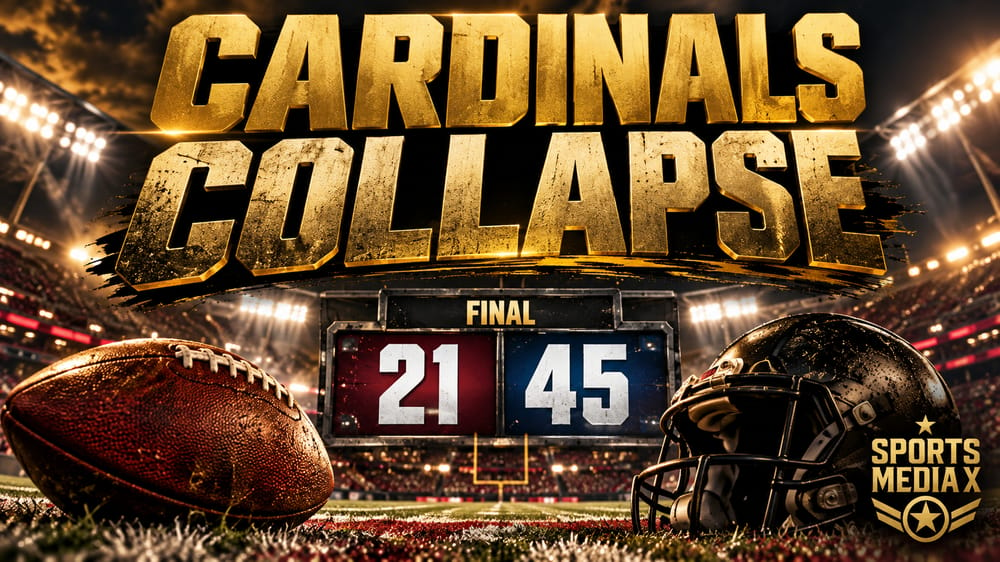
Arizona Cardinals vs. Detroit Lions: This Was More Than a Bad Loss
GLENDALE, Ariz. — For approximately one quarter Sunday afternoon, the Arizona Cardinals looked like a football team prepared to compete with the Detroit Lions. The offense opened the game with a touchdown. The defense forced three consecutive three-and-outs. State Farm Stadium had reason to believe the Cardinals might finally put together the kind of complete performance their season desperately needed.
Then everything fell apart.
The Detroit Lions dismantled the Arizona Cardinals 45–21 on Sunday, October 11, 2026, turning a promising opening quarter into one of the most embarrassing performances of Arizona's young season. Detroit scored 24 unanswered points in the second quarter, eventually built a 31-point advantage, and exposed fundamental problems that extend well beyond the quarterback position.
Arizona fell to 1–4, suffering its fourth consecutive defeat and ninth consecutive home loss. Detroit improved to 3–2 after overcoming a slow start and dominating nearly every meaningful phase of the game.
The Cardinals allowed 412 yards of total offense, surrendered 163 rushing yards, gave up five sacks, and managed only 56 rushing yards of their own.
But the most concerning part of Sunday's loss wasn't any individual statistic.
It was the complete inability to respond once Detroit made adjustments.
The Cardinals didn't lose because of one interception, one missed tackle, one blown assignment, or one questionable coaching decision. They lost because the entire operation failed to execute consistently after the opening possessions.
For a franchise trying to establish a new identity under head coach Mike LaFleur, that should set off alarms throughout the organization.
Cardinals Start Strong Before Detroit Takes Complete Control
Arizona's opening possession offered exactly what Cardinals fans wanted to see.
Veteran quarterback Jacoby Brissett moved the offense down the field and connected with tight end Teagan Quitoriano for a two-yard touchdown reception. The Cardinals grabbed an early 7–0 advantage and appeared comfortable attacking Detroit's defense.
Defensively, Arizona was equally impressive early.
The Lions opened with three consecutive three-and-outs, and quarterback Jared Goff struggled to establish any offensive rhythm. The Cardinals were getting off the field, winning early downs, and keeping Detroit's explosive offense under control.
Everything changed in the second quarter.
Detroit running back Jahmyr Gibbs scored from one yard out to tie the game. Goff later connected with tight end Sam LaPorta for a 38-yard touchdown, giving Detroit its first lead.
Wide receiver Jameson Williams added an eight-yard touchdown reception as the Lions continued building momentum.
Meanwhile, Arizona's offense completely disappeared.
Following its opening touchdown, the Cardinals produced five consecutive three-and-outs, gaining just 12 yards during that stretch.
Brissett also threw an interception before halftime.
By the time the teams entered their locker rooms, Detroit had transformed a seven-point deficit into a 24–7 advantage.
That 24-point second quarter ultimately defined the game.
Arizona had started with the right approach, but when Detroit adjusted, the Cardinals had no effective counterpunch.
Arizona Cardinals Offense: Five Consecutive Three-and-Outs Tell the Story
The Cardinals finished Sunday's game with 327 total offensive yards, 271 net passing yards, and three passing touchdowns.
Those numbers might suggest the offense had some success.
The game itself told a very different story.
Arizona's inability to sustain drives during the decisive portion of the contest left its defense repeatedly returning to the field and allowed Detroit to dictate the pace.
Five consecutive three-and-outs represent more than an unfortunate offensive stretch. They demonstrate a failure to maintain manageable down-and-distance situations, establish the running game, protect the quarterback, and consistently create favorable matchups.
The Lions weren't simply winning individual battles. They were disrupting the entire structure of Arizona's offense.
This was particularly troubling considering Detroit entered the matchup allowing an average of 31.8 points per game.
Arizona had an opportunity to exploit a vulnerable defense.
Instead, the Cardinals managed only seven first-half points.
For a team already struggling to establish consistency, that is unacceptable.
Jacoby Brissett's Statistics Don't Tell the Entire Story
Jacoby Brissett completed 29 of 47 passes for 292 yards, three touchdowns, and one interception against Detroit.
On the surface, those statistics look relatively productive.
But context matters.
Arizona scored two of its three touchdowns after falling behind by at least 24 points. By that stage, Detroit had already established control, and the Cardinals were throwing primarily because the scoreboard demanded it.
Brissett was also sacked five times, further illustrating the protection problems that disrupted Arizona's offensive rhythm.
Was Brissett perfect? Absolutely not.
His interception was costly, and the offense struggled to sustain drives while the game remained competitive.
But reducing Sunday's defeat to quarterback play would be an oversimplification.
Brissett did not surrender 45 points. He did not allow 163 rushing yards. He did not fail to create running lanes for Arizona's backs, and he was not responsible for every protection breakdown.
The Cardinals have problems that cannot be solved simply by changing the player taking snaps.
That distinction matters, especially with rookie quarterback Carson Beck waiting for his opportunity.
Arizona Cardinals Running Game Completely Disappears Against Detroit
One of the most alarming statistics from Sunday's loss was Arizona's rushing production.
The Cardinals finished with just 56 yards on 18 rushing attempts, averaging approximately 3.1 yards per carry.
Jeremiyah Love was held to 22 yards on 12 carries, an average of only 1.8 yards per attempt.
Arizona's inability to establish the ground game made an already difficult offensive situation significantly worse.
Without a credible rushing threat, Detroit could pressure Brissett, attack predictable passing situations, and force the Cardinals to execute difficult third-down plays.
An effective running game does more than produce yards.
It creates manageable second and third downs, supports play-action concepts, limits defensive pressure, and allows an offense to control the tempo.
Arizona accomplished very little of that Sunday.
The offensive line struggled to create consistent movement at the point of attack, and the Cardinals never established the physical identity necessary to challenge Detroit.
The rushing disparity was especially embarrassing considering what happened on the other side of the football.
While Arizona managed 56 rushing yards, Detroit produced 163.
That 107-yard difference reflected a significant imbalance in physical execution.
The Lions could run the football when they needed to.
The Cardinals couldn't.
And when one team can consistently control the line of scrimmage while the other cannot, the outcome becomes increasingly predictable.
Jahmyr Gibbs Destroys Arizona Cardinals Defense With 207 Yards From Scrimmage
Detroit running back Jahmyr Gibbs was the most dangerous offensive player on the field Sunday.
Gibbs rushed for 151 yards and two touchdowns while adding 56 receiving yards, finishing with 207 yards from scrimmage.
His performance was a nightmare for Arizona's defense.
The Cardinals struggled to contain Gibbs at the line of scrimmage, failed to consistently finish tackles, and repeatedly allowed him to create additional yardage after defenders had opportunities to bring him down.
Gibbs scored on a one-yard touchdown run in the second quarter and added another touchdown from three yards out in the fourth.
His performance also carried historical significance.
With 58 touchdowns before his 25th birthday, Gibbs surpassed Detroit legend Barry Sanders for the most touchdowns by an NFL player before turning 25.
That is an extraordinary accomplishment, but for Arizona, it represents another frustrating example of an opposing offensive star taking over a game.
The Cardinals knew Gibbs was a centerpiece of Detroit's offense.
They still couldn't stop him.
Jared Goff Recovers From Terrible Start and Punishes Arizona Secondary
Detroit quarterback Jared Goff completed 19 of 30 passes for 271 yards, three touchdowns, and zero interceptions.
He also scored on a one-yard rushing touchdown.
Those numbers are impressive considering how poorly Detroit's offense started.
The Lions gained negative nine yards across their first three possessions, all ending in punts.
But once Detroit found its rhythm, Arizona struggled to force stops.
Goff connected with Sam LaPorta for a 38-yard touchdown and found Jameson Williams for touchdown receptions of eight and 39 yards.
Williams delivered his first career game with multiple receiving touchdowns.
LaPorta finished with five receptions for 88 yards and a touchdown, consistently creating problems for Arizona's coverage.
The Lions repeatedly exploited defensive breakdowns, particularly when Arizona needed critical stops.
Goff didn't have to play perfectly.
He simply needed to execute Detroit's offense once the Cardinals began losing their defensive discipline.
And after the first quarter, that's exactly what happened.
Detroit's Fourth-Down Aggressiveness Exposes Arizona's Defensive Failures
One of the defining elements of Sunday's game was Detroit head coach Dan Campbell's willingness to attack Arizona on fourth down.
The Lions converted all four of their fourth-down attempts, including three that resulted directly in touchdowns.
Think about what that means.
Arizona had multiple opportunities to force Detroit off the field and change the direction of the game.
Instead, the Lions repeatedly extended possessions or scored.
That isn't just a statistical problem.
It's a failure to execute in some of football's most important situations.
Fourth-down defense requires communication, disciplined assignments, sound tackling, and the ability to anticipate an opponent's preferred concepts.
Arizona repeatedly came up short.
The Lions also converted all four of their red-zone opportunities into touchdowns.
For a Cardinals defense already struggling through a difficult opening month, Sunday's performance raised serious questions about the unit's ability to execute under pressure.
Nick Rallis and the Arizona Cardinals Defense Face Serious Questions
Defensive coordinator Nick Rallis faces increasing scrutiny after another disappointing performance.
Arizona has now allowed at least 31 points in four consecutive losses.
The Cardinals surrendered 45 against Detroit, their highest total allowed this season.
That isn't an isolated bad afternoon.
It's a troubling pattern.
The defense showed during the opening quarter that it could disrupt Goff and Detroit's offensive rhythm. But once the Lions adjusted, Arizona failed to consistently regain control.
The problems were visible across multiple areas.
The defensive front struggled to contain Gibbs. The secondary surrendered explosive passing touchdowns. The defense couldn't get off the field on fourth down. And the unit failed to produce the timely stops necessary to keep Arizona competitive.
This doesn't mean every problem belongs to Rallis.
Players must execute assignments, win individual matchups, and finish tackles.
But coaching is responsible for preparation, communication, adjustments, and putting players in positions to succeed.
Arizona's inability to respond to Detroit's offensive changes deserves serious examination.
When an opponent scores on seven consecutive possessions, including six touchdowns, the conversation must extend beyond individual mistakes.
The Cardinals need to determine why their defensive approach continues to break down after opponents find success.
Mike LaFleur's Cardinals Coaching Staff Must Take Accountability
Mike LaFleur inherited the challenge of establishing a new culture and building a competitive identity in Arizona.
Through five games, the results have been deeply concerning.
The Cardinals opened the season with a victory but have now lost four consecutive games.
Against Detroit, the coaching staff couldn't sustain early offensive success, couldn't establish the running game, and couldn't stop the Lions once they began attacking Arizona's defensive weaknesses.
LaFleur's offensive background makes the struggles on that side of the football particularly frustrating.
The Cardinals have enough offensive talent to expect better than five consecutive three-and-outs during a competitive game.
Arizona also needs to find a way to generate meaningful offensive production before opponents establish overwhelming leads.
Scoring touchdowns after falling behind by 24 or 31 points doesn't erase the problems that created those deficits.
LaFleur deserves time to implement his system.
But time alone won't fix repeated failures in execution.
The Cardinals need measurable improvement, and they need it quickly.
Marvin Harrison Jr. Traded to Houston Texans During Cardinals' Loss
As if Sunday's performance wasn't chaotic enough, the Cardinals also completed a major roster move involving former fourth-overall draft selection Marvin Harrison Jr.
Arizona traded Harrison to the Houston Texans in a deal reportedly involving a 2027 second-round pick and sixth-round pick coming to the Cardinals, with Houston also receiving Arizona's 2027 seventh-round selection.
The trade became public during Sunday's game, although Cardinals players had learned about the expected move Saturday.
Harrison entered the season with significant expectations but had managed just five receptions for 85 yards and one touchdown through four games.
His departure represents a major organizational decision.
Arizona invested a premium draft selection in Harrison in 2024, expecting him to develop into a cornerstone of the franchise's passing attack.
Instead, the Cardinals are moving forward without him less than three seasons later.
The trade creates additional questions about Arizona's offensive development, roster construction, and long-term direction.
It also removes another potential weapon from an offense already struggling to establish consistency.
While the additional draft capital could help Arizona rebuild its roster, the organization must eventually demonstrate that it can turn premium investments into sustained on-field production.
The Harrison trade shouldn't be used as an excuse for Sunday's defeat.
But it adds another layer of uncertainty to a franchise desperately searching for stability.
Trey McBride and Teagan Quitoriano Provide Rare Offensive Bright Spots
Despite the ugly final score, Arizona received meaningful contributions from its tight ends.
Teagan Quitoriano caught two touchdown passes from Brissett, including the Cardinals' opening score and a 13-yard touchdown in the third quarter.
Trey McBride finished with nine receptions for 66 yards and a touchdown.
McBride's late nine-yard touchdown reception was one of the game's most impressive individual plays for Arizona, showcasing the athleticism and reliability that have made him such an important offensive weapon.
However, much of McBride's production came after Detroit had already established control.
That distinction is important.
Arizona needs its most productive offensive players involved when games remain competitive, not simply during late comeback attempts against large deficits.
McBride remains a foundational piece of the Cardinals' offense.
The challenge for LaFleur and his staff is finding more effective ways to create opportunities for him throughout the game.
Should the Arizona Cardinals Start Rookie Quarterback Carson Beck?
With Arizona falling to 1–4, speculation surrounding rookie quarterback Carson Beck will only intensify.
The temptation to make a quarterback change is understandable.
Fans want to see progress. The offense has struggled. And when a season begins slipping away, attention naturally turns toward the future.
But the Cardinals must avoid confusing a quarterback change with a solution.
Sunday's loss demonstrated that Arizona's offensive problems extend far beyond Brissett.
The running game produced only 56 yards. The offensive line surrendered five sacks. The offense repeatedly failed to sustain possessions. And the defense allowed 45 points.
Starting Beck would not automatically solve any of those problems.
In fact, placing a rookie quarterback into an offense struggling with protection and rushing efficiency could create additional developmental challenges.
Beck's eventual opportunity should be based on his preparation, understanding of the offense, and the coaching staff's ability to provide a functional environment around him.
There is a legitimate argument for allowing Brissett to continue starting while Arizona improves its offensive structure.
There is also a reasonable argument for giving Beck meaningful experience later in the season once the coaching staff has established a more reliable foundation.
But making a quarterback change simply because the Cardinals lost another game would be reactionary.
Arizona needs to evaluate the entire offense before deciding that a rookie quarterback is the answer.
Nine Consecutive Home Losses: State Farm Stadium Has Lost Its Advantage
One of the most troubling developments surrounding Arizona's season is the team's continued inability to win at home.
Following Sunday's defeat, the Cardinals have now lost nine consecutive games at State Farm Stadium.
That streak has lasted more than a year.
Home-field advantage is supposed to provide familiarity, crowd energy, and an environment that makes opponents uncomfortable.
For Arizona, none of those advantages have translated into victories.
Sunday's game was particularly frustrating because the Cardinals initially gave their home crowd a reason to believe.
They scored first, played aggressive defense, and appeared capable of controlling the matchup.
Then Detroit took over.
The Lions left Glendale with a convincing victory while Arizona's home losing streak continued.
For a franchise trying to rebuild credibility with its fan base, consistently losing at home is a significant problem.
The Cardinals must make State Farm Stadium a difficult place for opponents to play again.
Right now, opposing teams are leaving Arizona with far too many comfortable victories.
Cardinals vs. Rams Week 6 Preview: Arizona Faces Another Major Test
The Cardinals won't have much time to recover from Sunday's embarrassment.
Arizona travels to face the Los Angeles Rams on Sunday, October 18, in another important NFC West matchup.
The Rams present another difficult challenge for a Cardinals team struggling with offensive consistency and defensive execution.
Arizona must improve its offensive line play, establish a more credible rushing attack, and eliminate the extended stretches of ineffective offensive possessions that have repeatedly damaged its chances.
Defensively, the Cardinals need better tackling, stronger communication, and more reliable execution in critical situations.
The coaching staff must also demonstrate that it can adjust when opponents begin exploiting weaknesses.
At 1–4, Arizona is quickly approaching the point where conversations about playoff possibilities will give way to questions about long-term development and organizational direction.
The Cardinals cannot afford another performance like Sunday's.
Sports Media X Verdict: This Was a Complete Team Loss, Not a Quarterback Loss
The Arizona Cardinals' 45–21 defeat against the Detroit Lions should serve as a serious warning about the current state of the franchise.
The Cardinals weren't beaten because of one player.
They were beaten because Detroit controlled the line of scrimmage, established its rushing attack, created explosive passing plays, converted critical fourth downs, and made the adjustments Arizona couldn't match.
Brissett made mistakes, but he also threw three touchdown passes while operating behind inconsistent protection.
The running game never established itself.
The defense allowed six touchdowns during seven consecutive scoring possessions.
The coaching staff couldn't find answers once Detroit changed its approach.
And the organization completed a major trade involving one of its highest-profile draft selections while the team was suffering another embarrassing home defeat.
That is not a quarterback problem.
That is a team problem.
The Cardinals have talent. They have young players worth developing. They have a coaching staff trying to establish a new identity.
But talent and potential mean very little without execution.
Arizona doesn't need another convenient scapegoat.
It needs accountability throughout the organization, better preparation, more effective adjustments, and a commitment to fixing the problems that continue appearing every Sunday.
The Cardinals are 1–4 because they are not consistently playing winning football. Until that changes, replacing the quarterback won't change the bigger picture.
For Arizona, the challenge is no longer identifying whether problems exist.
It's proving the organization knows how to fix them.
And after Sunday's disaster against Detroit, that answer cannot come soon enough.
Past Cardinals Articles:
Cardinals vs Lions Week 5 Preview: Arizona’s Protection Meets Detroit’s Firepower
Cardinals Collapse Against Giants: Arizona’s 36-24 Loss Was a Complete Team Failure
Cardinals Coverage Home
Arizona Cardinals Website

Talking. Covering. Creating. Building.
Learn
Sports Media X Course
SMX Press Box Newsletter
Resource Center
Content
Podcast
Videos
YouTube
Company
About
Contact
Editorial Standards
Fantasy + DFS Policy
Privacy Policy
Terms of Use
© 2026 Sports Media X.
A No Boss No Rush LLC Company.
Scottsdale, Arizona.