
Arizona State Collapses: Sun Devils Blow 17-Point Lead in Stunning Overtime Loss to Oklahoma State
Sunday, November 22, 2026
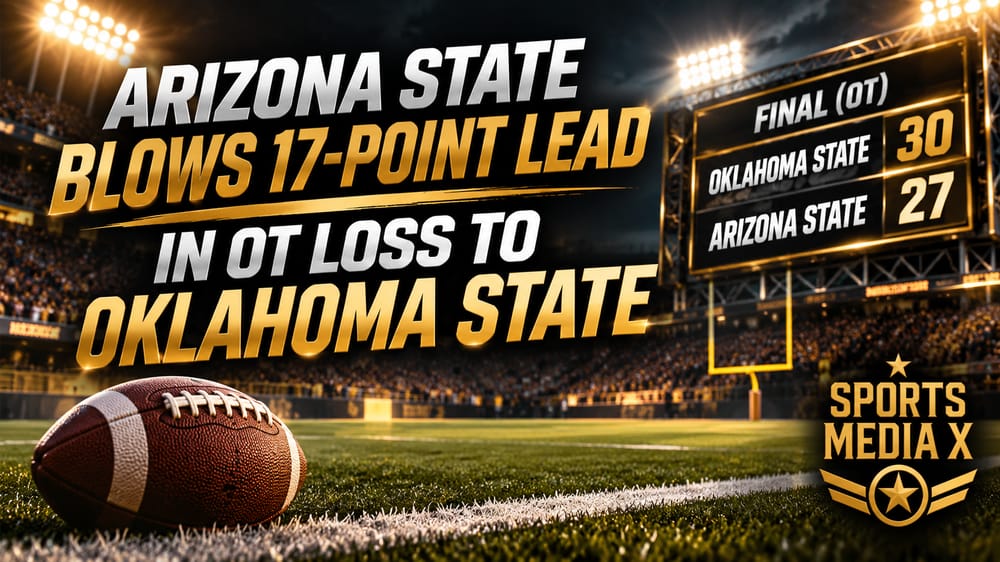
TEMPE, Ariz. — November 21, 2026 — For 30 minutes Saturday night, Arizona State looked like a football team determined to finish its home schedule with a statement victory. The Sun Devils were moving the football, making explosive plays, controlling the scoreboard and putting themselves in position to secure their seventh win of the season.
Then everything unraveled.
Arizona State surrendered a 17-point halftime advantage, watched its offense disappear for much of the second half and ultimately suffered a devastating 30-27 overtime loss to Oklahoma State at Mountain America Stadium.
What should have been a celebration in Tempe instead became one of the most frustrating defeats of the Kenny Dillingham era.
The Sun Devils led 24-7 at halftime. They had scored 24 unanswered points. Quarterback Jake Fette was delivering big plays, wide receiver Reed Harris was putting together an outstanding performance, and Oklahoma State appeared to have few answers for Arizona State's offensive attack.
But college football games aren't decided at halftime.
Oklahoma State responded with 17 unanswered points of its own, erased the deficit and forced overtime before a spectacular one-handed interception by Cowboys safety Quinton Hammonds ended Arizona State's night.
The defeat dropped Arizona State to 6-5 overall and 4-4 in Big 12 Conference play, sending the Sun Devils into their regular-season finale against rival Arizona with far more questions than answers.
Arizona State Dominates the First Half Against Oklahoma State
The opening quarter provided little indication of the chaos that would eventually unfold.
Oklahoma State struck first when William Mason scored on a 13-yard touchdown run, giving the Cowboys an early 7-0 advantage.
Arizona State answered with an eight-play, 64-yard scoring drive that demonstrated the offensive efficiency the Sun Devils would enjoy throughout the first half.
Fette connected with Harris on a one-yard touchdown pass to tie the game at seven.
From there, Arizona State seized control.
The Sun Devils took their first lead when Fette scored on a one-yard quarterback run in the second quarter. The touchdown capped another productive possession and gave Arizona State a 14-7 advantage.
Then came one of the game's most electrifying plays.
Fette found Harris for a 60-yard touchdown reception, sending Mountain America Stadium into celebration and extending Arizona State's lead to 21-7.
The connection between Fette and Harris was nearly unstoppable during the opening half. Oklahoma State struggled to contain Harris, and Arizona State repeatedly demonstrated its ability to create explosive plays through the passing game.
The Sun Devils weren't finished.
As the first half expired, kicker Carson Smith connected on a 51-yard field goal, sending Arizona State into the locker room with a commanding 24-7 lead.
At that moment, everything appeared to be working.
Arizona State had the momentum, the home-field advantage and a three-possession cushion.
The Sun Devils had also demonstrated that they could score through the air, on the ground and with their kicking game.
What they couldn't do was sustain that success.
Oklahoma State's Second-Half Comeback Changes Everything
Football is a game of adjustments, and Oklahoma State made the ones that mattered.
The Cowboys emerged from halftime with renewed energy, a more effective offensive approach and a defense that suddenly appeared capable of stopping Arizona State.
The Sun Devils, meanwhile, looked like an entirely different team.
Oklahoma State began its comeback when Caleb Hawkins scored on a nine-yard touchdown run, cutting Arizona State's lead to 24-14.
The drive also produced a significant defensive setback for the Sun Devils when safety Adrian "Boogie" Wilson was ejected for targeting.
Losing a defensive contributor during a game in which the Cowboys were beginning to find offensive rhythm only complicated Arizona State's problems.
Oklahoma State continued applying pressure, and Sam Keltner connected on a 25-yard field goal to make the score 24-17.
Suddenly, a game Arizona State appeared to have under control was becoming increasingly uncomfortable.
The most alarming development wasn't simply Oklahoma State's offensive improvement.
It was Arizona State's inability to respond.
The Sun Devils managed only 25 yards of offense during the third quarter.
Twenty-five yards.
For a team that had scored 24 points before halftime, the offensive disappearance was staggering.
Arizona State couldn't consistently establish its running game, couldn't sustain possessions and couldn't find the explosive passing plays that had defined the opening half.
The Cowboys had changed the direction of the game, and the Sun Devils were struggling to change it back.
A 17-Point Lead Disappears in the Fourth Quarter
Oklahoma State completed its comeback early in the fourth quarter.
Hawkins scored his second touchdown of the night on a seven-yard run with 9:11 remaining, tying the game at 24.
The Cowboys had erased a 17-point deficit.
Arizona State had surrendered 17 consecutive points.
And a stadium that had been celebrating a potential comfortable victory was suddenly watching a fourth-quarter battle.
To Arizona State's credit, the Sun Devils managed to respond.
With 3:12 remaining, Smith connected on a 38-yard field goal, restoring a 27-24 advantage.
The kick gave Arizona State an opportunity to escape with a victory despite its second-half struggles.
All the Sun Devils needed was one defensive stop.
They didn't get it.
Oklahoma State quarterback Drew Mestemaker directed another scoring possession, moving the Cowboys into position for a game-tying field goal.
Keltner delivered from 43 yards with 1:11 remaining, tying the game at 27.
Arizona State couldn't produce a winning score before regulation expired.
After leading by 17 points at halftime, the Sun Devils were headed to overtime.
Jake Fette's First Career Interception Ends Arizona State's Night
The overtime period was brief, dramatic and devastating for Arizona State.
Oklahoma State received the first possession and failed to reach the end zone, but Keltner converted a 35-yard field goal to give the Cowboys a 30-27 advantage.
That put the game in Arizona State's hands.
A touchdown would win it.
A field goal would extend overtime.
The Sun Devils had an opportunity to erase the disappointment of their second-half collapse and still walk away victorious.
Instead, the game ended on their first offensive play.
Arizona State attempted a trick-play pass, but Oklahoma State safety Quinton Hammonds read the play and produced a spectacular one-handed interception.
Game over.
Cowboys win, 30-27.
For Fette, the interception was especially painful because it was the first of his collegiate career.
The freshman quarterback had spent much of the night demonstrating his potential. He had delivered explosive throws, accounted for three touchdowns and helped build what appeared to be a comfortable advantage.
But the final play became the defining image of the defeat.
That doesn't mean Fette deserves the blame for Arizona State's loss.
Far from it.
The Sun Devils had multiple opportunities to put Oklahoma State away before overtime ever began.
The offense failed to maintain its production, the defense surrendered the lead and the coaching staff couldn't find the necessary adjustments to preserve a 17-point advantage.
The interception ended the game.
The collapse started long before it.
Reed Harris Delivers Outstanding Performance Despite Arizona State Loss
If there was a clear offensive bright spot for Arizona State, it was Reed Harris.
The Sun Devils wide receiver delivered one of his most productive performances of the season, finishing with 11 receptions for 172 yards and two touchdowns.
Harris was responsible for both of Fette's touchdown passes, including the spectacular 60-yard scoring reception that helped Arizona State build its first-half advantage.
His performance demonstrated how dangerous the Sun Devils can be when their passing attack is operating effectively.
Harris consistently created opportunities, produced explosive yardage and provided Fette with a reliable target.
Unfortunately for Arizona State, his outstanding individual effort wasn't enough.
Fette finished 17-of-29 passing for 232 yards, two touchdowns and one interception. He also contributed a rushing touchdown.
Cardae Mack led the Sun Devils' ground attack with 66 rushing yards.
Smith was another bright spot, converting both of his field-goal attempts from 51 and 38 yards while making all three extra points.
His performance kept Arizona State competitive and briefly restored the lead late in regulation.
But football is ultimately a team sport, and individual excellence couldn't overcome Arizona State's collective second-half struggles.
Oklahoma State Finds the Offensive Answers Arizona State Couldn't
While Arizona State struggled after halftime, Oklahoma State found exactly what it needed.
Mestemaker completed 30 of 40 passes for 294 yards, repeatedly putting the Cowboys in position to extend drives and create scoring opportunities.
Hawkins delivered the critical rushing production, finishing with 98 yards and two touchdowns.
Both of his scores came during Oklahoma State's comeback.
Justin Bowick added seven receptions for 95 yards, providing Mestemaker with another reliable receiving option.
Defensively, Jerry Lawson made a major impact with seven tackles, two sacks and three tackles for loss.
The Cowboys also received the decisive defensive play from Hammonds, whose overtime interception sealed the victory.
Oklahoma State finished with 408 total yards compared with Arizona State's 352.
The Cowboys also produced 26 first downs to the Sun Devils' 16.
Those numbers tell an important story.
Arizona State created explosive plays, particularly in the first half.
Oklahoma State ultimately did a better job sustaining offensive possessions and maintaining pressure throughout the game.
The difference became increasingly obvious as the second half unfolded.
Third-Down Failures Expose Arizona State's Offensive Problems
One of the most troubling statistics from Saturday's loss was Arizona State's third-down performance.
The Sun Devils converted just three of 15 third-down opportunities.
That's a 20 percent conversion rate.
For an offense trying to protect a substantial halftime advantage, that kind of inefficiency is a recipe for disaster.
Arizona State couldn't consistently extend possessions, couldn't keep Oklahoma State's offense off the field and couldn't generate the sustained drives necessary to regain momentum.
Interestingly, the Sun Devils converted all five of their fourth-down attempts.
That contrast reveals just how unusual the offensive performance became.
Arizona State found ways to execute when facing fourth down but struggled repeatedly to produce the necessary yardage one play earlier.
The result was an offense that became increasingly dependent on difficult situations rather than controlling the game through consistent execution.
The Sun Devils finished with 120 rushing yards and 232 passing yards.
Those totals weren't disastrous in isolation.
But when combined with the third-down failures, second-half production and inability to protect the lead, they help explain why Arizona State couldn't finish the job.
Arizona State's Defense Couldn't Protect the Lead
The offensive collapse deserves significant attention, but Arizona State's defense also carries responsibility for the loss.
The Sun Devils entered halftime having allowed only seven points.
They surrendered 20 points in the second half and another three in overtime.
Oklahoma State's ability to establish a more effective offensive rhythm exposed Arizona State's defensive vulnerabilities.
The Cowboys used their rushing attack to generate scoring opportunities and relied on Mestemaker's passing efficiency to sustain drives.
Wilson's targeting ejection further complicated the situation, reducing Arizona State's available defensive personnel at a critical point.
The Sun Devils also faced injuries in the secondary, limiting their flexibility as Oklahoma State increased its offensive pressure.
Dillingham acknowledged afterward that Arizona State may have become too conservative defensively.
That possibility deserves examination.
When a team builds a substantial lead, protecting against explosive plays becomes important.
But playing too cautiously can also create opportunities for an opponent to move the football methodically down the field.
Oklahoma State took advantage of Arizona State's inability to consistently disrupt its offensive rhythm.
The result was a comeback that never should have been allowed to develop.
Kenny Dillingham Faces Difficult Questions After the Collapse
Every head coach faces difficult losses.
But some defeats demand more examination than others.
Saturday's loss belongs in that category.
Arizona State didn't lose because Oklahoma State dominated from the opening kickoff.
The Sun Devils built a 17-point halftime advantage at home.
They had the offensive production, the momentum and the opportunity to control the remainder of the game.
Then the situation changed dramatically.
The coaching staff must evaluate why the offense became so ineffective after halftime, why the defense struggled to adjust and whether different decisions could have changed the outcome.
The overtime play call will undoubtedly receive attention.
Attempting a trick play on the first offensive snap of overtime carried significant risk, particularly with Arizona State needing only a field goal to extend the game.
Creativity can win football games.
But execution and situational awareness matter just as much.
The decision ultimately produced the turnover that ended Arizona State's night.
Still, focusing exclusively on the overtime interception would overlook the larger issue.
Arizona State should never have needed overtime.
The Sun Devils had 30 minutes to protect a 17-point lead.
They couldn't do it.
That is the bigger concern heading into the final week of the regular season.
What Arizona State's Loss Means for the Big 12 Standings
Arizona State entered Saturday with an opportunity to strengthen its position in the Big 12 and build momentum heading into the regular-season finale.
Instead, the Sun Devils dropped to 6-5 overall and 4-4 in conference play.
Oklahoma State improved to 7-4 overall and 5-3 in Big 12 competition.
The loss doesn't eliminate Arizona State from bowl eligibility. The Sun Devils have already secured the six victories generally required to qualify for postseason consideration.
But it does change the outlook for the final stretch of the season.
A potential eight-win regular season is now off the table.
Arizona State can still finish 7-5 with a victory over Arizona, but the margin between a strong finish and a disappointing conclusion has become much smaller.
The Sun Devils must also confront a larger question.
Can they consistently finish games against competitive opponents?
Saturday's defeat exposed a team capable of playing outstanding football for stretches but unable to sustain that performance for four quarters.
That inconsistency is precisely what Arizona State must address moving forward.
The 100th Territorial Cup Now Becomes Arizona State's Biggest Test
There is little time for Arizona State to dwell on what happened against Oklahoma State.
The Sun Devils must now prepare for their annual rivalry showdown against the Arizona Wildcats.
And this isn't just another Territorial Cup.
The upcoming matchup marks the 100th meeting in one of college football's most passionate rivalries.
For Arizona State, the stakes extend beyond the rivalry trophy.
A victory would allow the Sun Devils to finish the regular season 7-5, build momentum heading into bowl season and provide a much-needed response to Saturday's collapse.
A loss would leave Arizona State at 6-6 and send the program into the postseason carrying consecutive defeats.
The Sun Devils must find a way to regroup emotionally and physically.
Fette will need to respond to the first interception of his college career.
The offense must rediscover the consistency that made it so dangerous during the first half against Oklahoma State.
The defense must demonstrate that it can adjust when opponents change their approach.
And Dillingham must ensure that his team doesn't allow one devastating loss to become two.
Rivalry games have a way of revealing a team's character.
Arizona State is about to find out plenty about its own.
Sports Media X Final Take: Arizona State Didn't Just Lose — It Let This One Get Away
There are losses you accept because the opponent was simply better.
There are losses that come down to one extraordinary play.
And then there are losses that leave an entire program wondering how a victory slipped through its fingers.
Arizona State's 30-27 overtime defeat against Oklahoma State falls squarely into that final category.
The Sun Devils had this game.
They had a 17-point halftime lead.
They had an explosive passing attack.
They had a receiver delivering an outstanding performance.
They had a quarterback who accounted for three touchdowns.
They even regained the lead late in the fourth quarter after watching their original advantage disappear.
And somehow, they still lost.
That's what makes this defeat so difficult to explain away.
Arizona State wasn't overwhelmed for four quarters.
It was outplayed when the game mattered most.
Oklahoma State deserves credit for making adjustments, executing its comeback and delivering the decisive play in overtime.
But Arizona State must take responsibility for allowing that comeback to happen.
The Sun Devils scored 24 points in the first half and just three in the second.
They surrendered 17 unanswered points.
They failed to convert 12 of their 15 third-down opportunities.
And when overtime presented one final chance to escape, the game ended on an interception.
One play will dominate the highlights.
But one play didn't lose this football game.
The Sun Devils lost it over the course of an entire second half.
Now comes the real test.
Arizona State has one regular-season game remaining, and it happens to be against its biggest rival.
The 100th Territorial Cup offers the Sun Devils an opportunity to change the conversation, restore confidence and finish the regular season with a victory.
But before they can do that, they must confront what happened Saturday night.
Because the difference between a good football team and a great one isn't simply the ability to build a 17-point lead.
It's knowing how to finish the job.
For continuing Arizona State Sun Devils coverage, Big 12 football analysis, game recaps and the latest Arizona sports headlines, follow Sports Media X at SportsMediaX.net.
Past Sun Devils Football Articles:
ASU vs. Oklahoma State Preview: Sun Devils Face Explosive Cowboys in Saturday Night Big 12 Showdown
Arizona State Overcomes Travel Chaos, Defeats UCF 26-13 to Clinch Bowl Eligibility
Sun Devils Football Coverage Home
Sun Devils Football Website

Talking. Covering. Creating. Building.
Learn
Sports Media X Course
SMX Press Box Newsletter
Resource Center
Content
Podcast
Videos
YouTube
Company
About
Contact
Editorial Standards
Fantasy + DFS Policy
Privacy Policy
Terms of Use
© 2026 Sports Media X.
A No Boss No Rush LLC Company.
Scottsdale, Arizona.